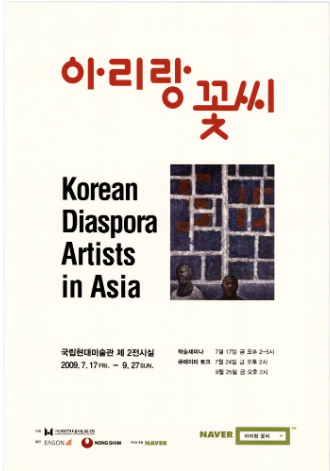
 Korean Diaspora Artists in Asia, Poster, 2009, MMCA Art Research Center Collection
Diaspora in Korean art carries the meaning of forced migration. Japan’s colonization and artists who defected to North Korea due to the Korean War and division of the country are prime examples of diaspora. People who moved abroad to escape poverty and colonial rule or to fight for independence could not return to their homeland after Korea’s liberation from Japan and ceasefire in the Korean War, and settled in foreign lands. Ethnic Koreans in China and Japan testify to the tragedy of the post-liberation conflict between North and South Korea. Diasporic artists include Cho Yanggyu, who went to North Korea from Japan, Shin Sunnam (Nikolai Sergeevich Shin), a descendant of Koreans who was forcibly relocated in 1937, and Pen Varlen, who was active in Russia. The second project of the Gwangju Biennale in 2002,
THERE: Sites of Korean Diaspora, was an exhibition that shed light on the reality of diaspora featuring Korean artists scattered around the world, including Japan and China as well as Central Asia, the United States, and South America. Young Soon Min, the curator of this exhibition, was also a diasporic artist. Even in the twentieth century, diasporas not by forced deportation, political repression, and exile but by adoptions continued. One such example is Jane Jin Kaisen, a Korean artist who was adopted to Denmark.
* Source: Multilingual Glossary of Korean Art. Korea Arts Management Service