
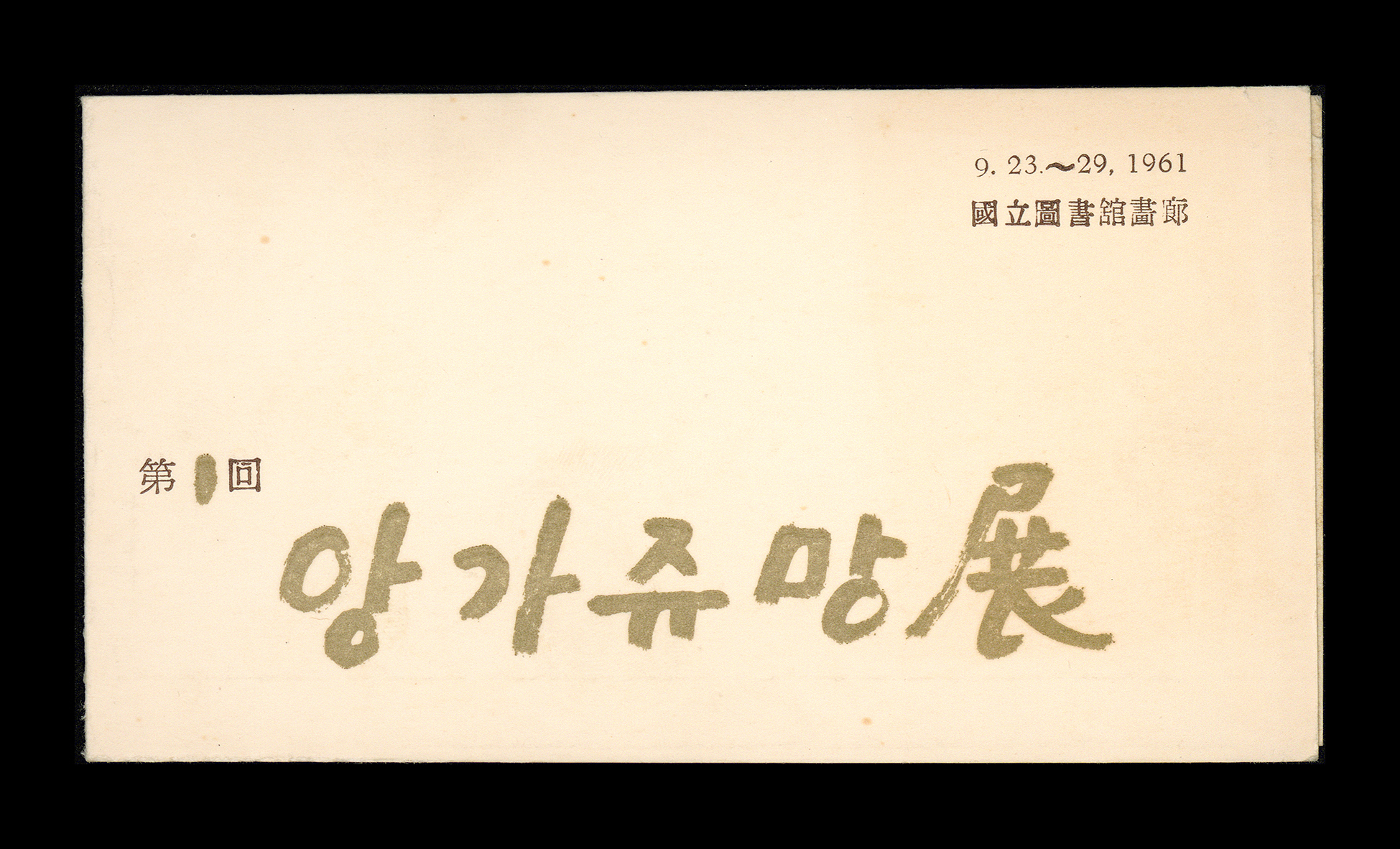
1st Exhibition of Engagement Associates, Leaflet, 1961. Image provided by MMCA Art Research center
Engagement


* Source: Multilingual Glossary of Korean Art. Korea Arts Management Service
Related
-

Semi-abstract
The term semi-abstraction refers to a painting that combines abstract and figurative painting styles together. Lee Ungno used the term in a different local context in relation to his work. In his book Appreciation and Technique of Eastern-style Painting (1956), Lee argues that semi-abstraction describes an artistic technique based on sketching from nature, which also further attempts to express an abstract atmosphere to better emphasize the author’s conceptual intentions. The concept was officially used in Korea at the 1961 Grand Art Exhibition of Korea to distinguish three divisions: western painting, semi-abstract work, and abstract work.
-
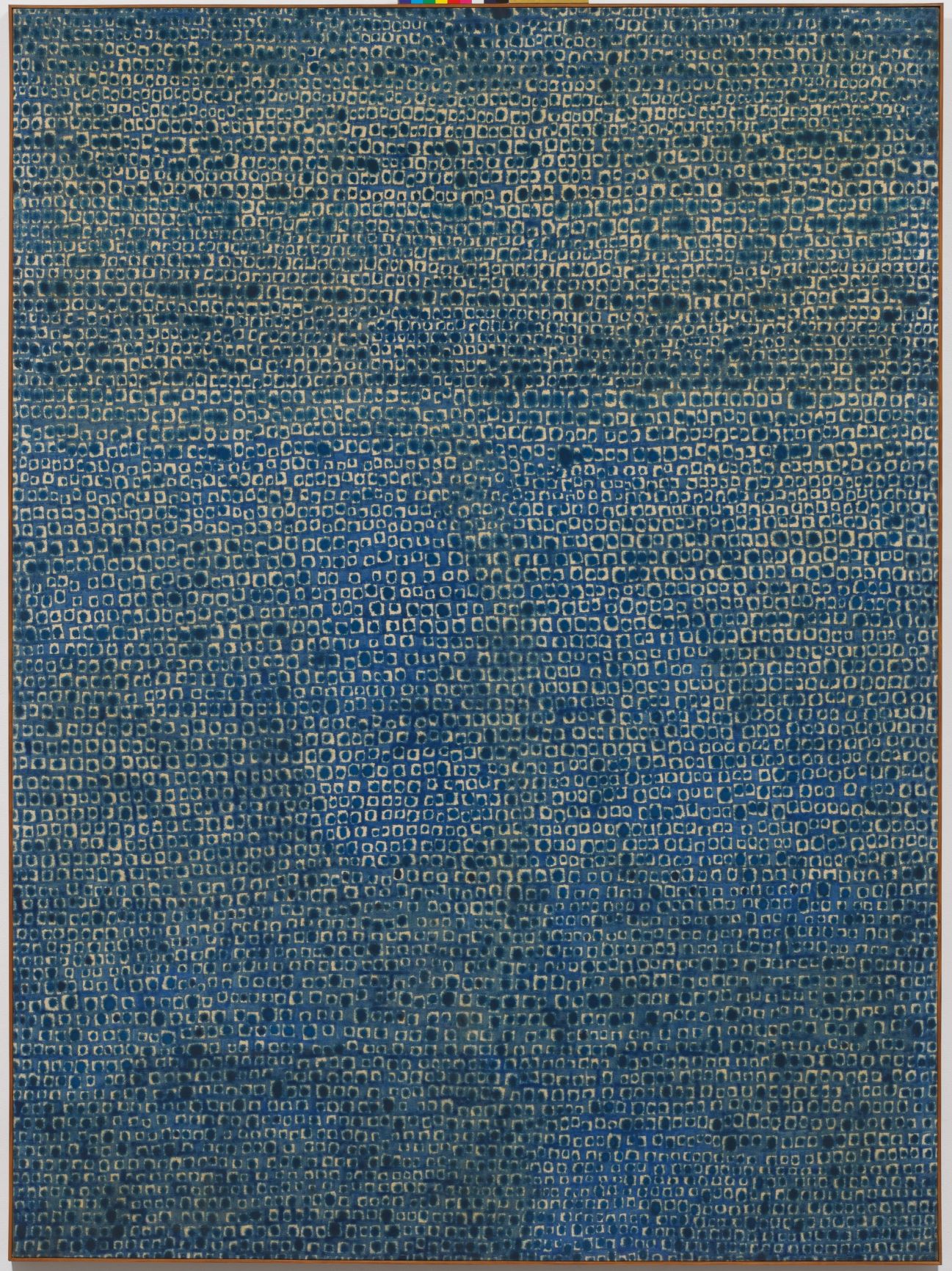
Abstract art
A term which can be used to describe any non-figurative painting or sculpture. Abstract art is also called non-representational art or non-objective art, and throughout the 20th century has constituted an important current in the development of Modernist art. In Korea, Abstract art was first introduced by Kim Whanki and Yoo Youngkuk, students in Japan who had participated in the Free Artists Association and the Avant-Garde Group Exhibition during the late 1930s. These artists, however, had little influence in Korea, and abstract art flourished only after the Korean War. In the 1950s so called “Cubist images,” which separated the object into numerous overlapping shapes, were often described as Abstractionist, but only with the emergence of Informel painting in the late 1950s could the term “abstract” be strictly used to describe the creation of works that did not reference any exterior subject matter. The abstract movements of geometric abstractionism and dansaekhwa dominated the art establishment in Korea in the late-1970s. By the 1980s, however, with the rising interest in the politically focused figurative art of Minjung, abstraction was often criticized as aestheticist, elitist, and Western-centric.
Timelines

Sign Up for Email Updates
Privacy policy & Terms and Conditions of Use
Privacy policy
1.1 All personal information maintained by the National Museum of Modern and Contemporary Art, Korea (hereinafter referred to as the “MMCA”) will be collected and possessed pursuant to relevant regulations or to consent from the information owners. MMCA shall handle personal information as follows: Items: E-mail of subscribers to the Website ‘MMCA Research Lab’ mmcaresearch.kr Purpose for Preservation: Member management (for E-mailing and etc.) Basis for Preservation: An agreement on the use of services Period of Preservation: 3 years (expires along with the cease of the membership)
※ Disclosure of registration matters of personal information from MMCA file Safety Administration Privacy comprehensivesupport portal (www.privacy.go.kr)→ individual complaint information → required inspection of personal information → personal information list browser menu
1.2 Following information will be collected and saved automatically to analyzing statistics for improvement and supplement of the Website. MMCA utilizes Google Analytics statistics cookie to determine how many users visit the Website as well as the Website’s traffic.
• Domain of your internet server and addresses of websites that you pass through and visiting time
• The user’s browser type and OS
2. Use and Sharing of Collected Information
2.1 MMCA shall not handle personal information beyond the extent informed or agreed and provide or disclose it to a third party. However, the cases of provision of information by the law or permitted extent of other laws are allowed.
2.2 When signing an entrustment contract with other public organization or other specialized organization, MMCA shall make them comply with the necessary limitation or procedures according to Gabia (Restrictions on Management of Personal Information Following Entrustment of Affairs) and inspect actual conditions.
2.3 MMCA’s personal information is strictly limited on use and provision. Article 18 (Restrictions on Use and Provision) of Personal Information Protection Act provides the guidelines as follows: 2.3.1 Where he/she has obtained the consent of a subject of information
2.3.2 Where special provisions exist in any other Act
2.3.3 Where it is deemed obviously necessary for physical safety and property interests of a subject of information or a third person when the subject of information or his/her legal representative cannot give prior consent as he/she is unable to express his/her intention or by reason of his/her unidentified address, etc.
2.3.4 Where personal information is necessary for compiling statistics, or scientific research purposes, etc., and the personal information is provided in a form by which a specific individual cannot be identified
2.3.5 Where using personal information for any purpose other than the intended purpose or a failure to provide a third person with such information makes it impossible to perform affairs provided for in any other Act, and this has undergone deliberation and resolution by the Protection Committee
2.3.6 Where it is necessary for providing a foreign government or international organization with personal information in order to implement a treaty or any other international agreement
2.3.7 Where it is necessary for investigating a crime, and instituting and sustaining a public prosecution
2.3.8 Where it is necessary for a court to perform its judicial affairs
2.3.9 Where it is necessary for executing a punishment, care and custody or protective disposition.
3. Removal of Contents
MMCA removes the provided information without haste when the purpose of collecting personal information is achieved. The process and the means of the removal are as follows:
3.1 For the protection of privacy, information provided by users to register membership, etc. is to be deleted after a certain period of sustainment for the purpose of information protection stipulated in the internal policies and related laws. The personal information is not used for other purposes except retention based on the law.
3.2 As for information printed on paper, MMCA uses paper cutters or destroy them by fire. As for digitized files, MMCA uses technical method to irreversibly delete the data.
4. Rights of information providers
Providers of personal information can claim their rights with regard to the protection of their personal information according to the Personal Information Protection Act Chapter 5.
4.1 Accessing provided personal information
4.2 Rectifying provided information and removing it from the Website
4.3 Stopping the provision of personal information
4.4 Method and processes for claiming the rights
4.5 Liability to compensate for damage
5. Inspection, Correction, Deletion, and Suspension of Personal Information
5.1 A subject of information may request inspection, correction, deletion, and suspension of personal information according to the Personal Information Protection Act Article 35 (Inspection of Personal Information), Article 36 (Correction or Deletion of Personal Information), and Article 37 (Suspension, etc. from Managing Personal Information)
• Process to request access: Request in person to department of personal information or “Privacy Information Protection Portal” (www.privacy.go.kr) Complaint of personal information → Request for inspection of personal information and etc. (public I-Pin real name authentication)
• Inquiry: Department of Planning and General Management, MMCA
5.2 Members have the right to access to their own information pursuant to according to the Personal Information Protection Act. However, access may be restricted at any event of the followings pursuant to Article 35 (4) of the Act
5.2.1 Where an inspection is prohibited or restricted by Acts
5.2.2 Where it is apprehended that any third person’s life and body may be harmed, or any third person’s property and other interests may be unduly infringed on
5.2.3 Where a public institution causes any inconvenience while carrying out any of the following affairs
5.2.3.1 Affairs concerning the imposition, collection, or refund of taxes
5.2.3.2 Affairs concerning grade evaluation or the selection of newly enrolled students at schools of each level under the Elementary and Secondary Education Act and the Higher Education Act, lifelong education centers under the Lifelong Education Act, and other higher education institutions established under other Acts
5.2.3.3 Affairs concerning tests of academic ability, functions and employment, and qualification evaluation
5.2.3.4 Affairs concerning an assessment or decision in progress in connection with the calculation, etc. of compensation or benefits
5.2.3.5 Affairs concerning an audit and an investigation in progress under other Acts
5.3 Members who have the right to access to their own information can request correction, deletion, or treatment cessation to the manager of personal information. However, if the personal information is specified in the collection target in other laws and regulations, you will not be able to request the deletion. The process is as follows:
Process to request access: Requesting Person (Information Subject) → Request by Form → Head of Possessing Agency → Decision to be Sent within 10days
6. Reporting infringements
6.1 Any person, who is damaged to their rights or interests damaged by treatment such as disclosure of personal information or the collection, use, offer, commission of personal information without the consent of the information subject, or not in accordance with the law while using the Website is able to report in the following way:
• Submission of Appeal/submitting via the website or visiting in person/corresponding organization
• Investment infringement fact/Check infringement, Visiting and research infringement organization/register book
• Processing/ Provisional Remedy/Remedy report
• Announcement of result/report to claimant and Minister of Security and Public Administration/ result letter of notification
In the event of an infringement of an information subject’s personal information, a complaint may be submitted to the Personal Information Infringement Report Center of the Korea Internet Security Agency (KISA) of Minister of Security and Public Administration (http://www.kisa.or.kr, Tel: 118) according to Personal Information Protection Act Article 62 (Reporting, etc. Facts of Infringements).
7. Administrative and technical Measures for Personal Information
7.1 MMCA maintains administrative and technical safeguards to protect against unauthorized disclosure, use, alteration or destruction of the personal information you submitted
7.2 Passwords are codified in cipher so that the providers might be only people who can manage their own personal information for themselves
7.3 MMCA tries to protect personal information from hackers or computer viruses. The latest vaccine program is used so as not to damage or leakage materials and personal information, and it can secure transmission of personal information on the network through encrypted communication. Proper measures shall be taken to protect the personal information processing system from intrusion by unauthorized parties, using an intruder detection system
7.4 Education and minimum of employees responsible for handling personal information
7.5 MMCA restricts access to personal information to the employees working as the staffs who need to know that information regularly renewed in order to process it and shall attend mandatory educational sessions on the relevant regulations.
7.6 MMCA tries to correct the problems immediately by frequently checking the compliance Privacy Policy and observation of the persons of charge. However, MMCA has no responsibility for problems derived from personal carelessness of the user or on the Internet information such as user ID, and password
8. Relief from Infringement of Rights
The personal information subject can request relief from personal information infringement and counseling. Please contact Institutions below as separate organizations from MMCA, if you need more help or not satisfied with the results from MMCA
8.1 Cyberprivacy Center: Appeal of personal information infringement, Consultation application
• Website: privacy.kisa.or.kr Contact Number: 118
• Postal Address: KISA CYBERPRIVACY Center, Jungdaero 135, Songpa-gu, Seoul 138-
8.2 Personal Information Dispute Mediation Committee: Personal information dispute mediation application, group conflict adjustment (civil settlement)
• Website: www.kopico.go.kr Contact Number: +82-2-1833-6972
• Postal Address: Personal Information Dispute Mediation Committee, 12 Floor, 209, Sejong-daero, Jongro-gu, Seoul 03171
8.3 Cyber Crimes Investigators (Supreme Prosecutor’s Office): +82-2-3408-3573 (www.spo.go.kr)
8.4 Cyber Terror Response Center: +82-1566-0112 (www.netan.go.kr)
9. Contact Information of Personal Information Protection Officer
Personal Information Protection head Officer of ‘MMCA Research Lab’
(mmcaresearch.kr): Sujong Song, Head of Dept. of Museum Policy & Research
Telephone: +82-2-3701-9640
Email: mmcaresearchlab@korea.kr
Adress: Department of Museum Policy & Research of MMCA, 30 Samcheong-ro, Sogyeok-dong, Jongno-gu, Seoul, 03062, Korea
Personal Information Protection Officer of ‘‘MMCA Research Lab’(mmcaresearch.kr): Yejin Kim, Curator, Dept. of Museum Policy & Research
Telephone: +82-2-3701-9638
Email: mmcaresearchlab@korea.kr
Adress: Department of Museum Policy & Research of MMCA, 30 Samcheong-ro, Sogyeok-dong, Jongno-gu, Seoul, 03062, Korea
10. This Privacy Policy is applied from August 1, 2022.
Terms and Conditions of Use
National Museum of Modern and Contemporary Art, Korea (hereinafter referred to as the “MMCA”) provides www.mmcaresearch.kr and its subdomains (including websites accessed through mobile devices as well as downloadable mobile applications) and application program interfaces ("APIs") (collectively, the "Website") in support of the MMCA's mission to collect, preserve, study, exhibit, and encourage appreciation for and advance knowledge of works of art. By subscribing to Website, users agree to the following terms and conditions that can be amended by MMCA at any time: It is recommended that you visit this page occasionally to review the current terms and conditions.
1. Usage Contract
1.1 This Terms and Conditions of Use shall be approved by the user subscribing his/her personal information in the form provided by MMCA on the member information screen.
1.2 MMCA shall cancel the subscription under any of the following conditions.
1.2.1 When applied using another person's name
1.2.2 When an applicant has written false information on the application form
1.2.3 Obstructing others’ usage of the services of this site or peculating the information provided
1.2.4 Acting to be forbidden by the law or this agreement using this site
1.2.5 Unfulfilling membership conditions designated by this site
1.3. MMCA can reserve to completing this usage contract until the following terms are resolved.
1.3.1 When there is not enough capacity for related services
1.3.2 When there are technical issues
1.4 Application to usage of this site with agreeing to the agreement is assumed as you agree for MMCA to collect and use your membership information.
2. Withdrawal of Membership
2.1 The member may request MMCA to be withdrawn from membership at any time through related menu in Website, in which case MMCA will process the request immediately by related law.
2.2 When the member terminates the contract, integrated posts registered in the individual account among the articles that member has created are deleted, and the service must be logged will not be available anymore.
2.3 MMCA may terminate or suspend membership, if any member conducts one of the following activities,
2.3.1 If provide false information of the membership application
2.3.2 If related to criminal activities
2.3.3 If another person's ID or password is misused
2.3.4 If interfere with the operation of MMCA’s service
2.3.5 If apply for the purposes of undermining public order and morals of the society
2.3.6 If defame or otherwise bringing harm to others
3. Copyright and Proprietary Rights
Text, images, audio, and other information such as data, software, documentation, and contents on the website (collectively, “Materials”) contained in multimedia files and clips used on the website are copyrighted or owned by the MMCA or its licensors (individuals, organizations, corporation).
4. Trademarks
Trademarks, service marks, and logos displayed on Website (collectively, the "Trademarks") are registered and/or unregistered Trademarks of MMCA or exhibition participating organizations. Trademarks of third parties may also be displayed on Website. Nothing contained on Website shall be construed as granting, by implication, estoppel, or otherwise, a license or right to use Trademarks displayed on Website without the express written permission of the MMCA or any third party to own Trademarks displayed on Website. Unauthorized use of Trademarks or other Materials is strictly prohibited, except as otherwise authorized in these Terms and Conditions.
5. Authorized Uses
Materials for authorized use fall into two categories
- Materials identified as Public Domain
- Materials MMCA considered to be under copyright or other restrictions
5.1 Materials identified as Public Domain
By giving up the rights to Materials identified as Public Domain, MMCA allows free use of such Materials for any purpose, including commercial and noncommercial use, without permission from MMCA. These open access to Materials is provided under a Creative Commons Zero (CC0) license.
5.2 Materials the MMCA considered to be under copyright or other restrictions
Materials considered by MMCA to be copyrighted or otherwise restricted may be used only for noncommercial, educational, or personal purposes use, or for fair use as defined in the Copyright Act of the Republic of Korea. Users may download these files for their own use, subject to additional conditions or restrictions that may apply to the individual files or programs. However, the user shall cite the author and source of the Materials as they would quote from any work, and the citations shall include the URL "www.watchandchill.kr" but shall not cite the Materials in a way that suggests the user’s endorsement or legal use of the Materials. Whether accessed directly from Website or via other sites or mechanisms, users shall agree to restrict the use of such files to non-commercial, educational, personal or fair use by downloading, printing, or using materials and not to infringe on the ownership of MMCA or other parties. Users may not remove any copyright, trademark, or other proprietary notices, including attribution information, credits, and copyright notices that have been placed on or near the Materials by MMCA. Downloading, printing, copying, distributing or using Materials for commercial purposes, including commercial publication or personal gain, is expressly prohibited. Unless the material is identified as a Public Domain, all rights not expressly granted here by MMCA are specific and fully reserved. MMCA does not guarantee that use of any Materials displayed on the Websites will not infringe the rights of third parties which are not owned nor affiliated with MMCA. For instance, some works may be copyrighted by the author or heirs who own rights in the work or may contain third-party trademarks or publicity rights. Captions may provide more information about the status of the work's rights. The work in which such rights are specified shall not be used arbitrarily in any form. Users shall not copy or download this work without prior permission from the holder of the underlying rights.
6. Security
By creating an account and password on Website, users agree to maintain the confidentiality of their login credentials and are responsible for restricting access to personal computers and mobile devices. Users agree to use Website only for lawful purposes and does not engage in any activity that compromises the security of the website or damages Website and its content.
7. User-Generated Content
By posting contents including comments, photos, reviews, and links to external sites on Website and using message services, users agree to comply with all requirements and procedures for posting and messaging, avoid using abusive and offensive language, refrain from posting commercial content and political commenting, and do not infringe on third parties’ rights, including privacy, copyright, trademarks, etc. MMCA do not support comments or recommendations posted by users or third parties. MMCA requires users to obtain all necessary rights or permission to use the author's works, copyrighted stories, or news articles written by others before posting or distributing content on Website. It is strictly prohibited to publish or transmit illegal, threatening, or infringing materials that may constitute an act that may be considered a criminal offence, create civil liability, violate privacy or publicity, or otherwise violate the law. MMCA holds the right to inspect, monitor, review, edit, remove, reject, or delete content for any reason, but it is not mandatory. The repeated intruder's access and account will be terminated in due course. MMCA does not guarantee that the use of Materials on Website does not violate the rights of third parties, and is not liable for errors, defamation, insults, omissions, falsehood, obscenity, pornography danger, or inaccuracies contained in information on such locations of Website.
Note: MMCA can stop some part of Website at any time. Comments shall not be deleted when requested by the user. By submitting comments, users acknowledge that they will be posted on the Internet. The user grants MMCA the right to quote the comments from any media that is currently known and will be created in the future. By posting or distributing information or materials on Website, users explicitly relinquish ownership of the comments, and such information or materials are freely copied and distributed by others without users’ permissions.
8. Personal Information Protection (Privacy Policy)
MMCA is committed to protecting the personal information of Website subscribers and visitors in accordance with relevant laws and regulations. All information collected from users regarding the use of Website apply to the privacy policy of MMCA. Website is not specifically for children and MMCA do not actively request information from children. Children under the age of 14 must obtain permission from their legal representatives before submitting personal identification or other content to the website.
9. Links
MMCA has not reviewed all sites or pages linked to Website and is not responsible for the content or privacy policies of any other site or page which Website links or is linked to. MMCA provides these links as a convenience, and links to pages off-site or to other sites are at the user’s own risk. Links do not imply endorsement or affiliation with the sites linked by MMCA.
10. Disclaimer of Warranties
Not limited to the foregoing, Material on Website is provided just as it is without any express or implied warranties of any kind, either implied warranties of merchantability, suitability for a particular use, copyright ownership, non-infringement, or other proprietary rights of third parties. MMCA may update, change, or delete content at any time. MMCA shall make reasonable and continuous efforts to modify and update Website, but does not guarantee that Website will provide continuous, fast, safe, or error-free services, nor shall it be liable for any damage or loss caused by users or third parties, including content inaccuracies or unavailability of Website. MMCA are not liable for viruses that may infect users’ computer equipment or other property by using Website or downloading data from Website, and do not compensate for such damage. MMCA may, at its discretion, suspend or delete Website, or sections or Materials within Website at any time.
11. Limitations of Liabilities
The affiliates, trustees, directors, executives, employees, or agents of MMCA or MMCA shall not be liable for direct, indirect, incidental, punitive, special or consequential damages arising out of or in connection with the use of Website or Materials.
12. Copyright Act
MMCA is doing its best to comply with the Korean Copyright Act and related laws (hereinafter referred to as the “Copyright Act, etc.”), and requires all users of Website to comply with these laws. Owners of works who believe their rights have been infringed under the Copyright Act, etc. may report a claim of infringement under the Copyright Act, etc. Copyright owners of all content shall contact MMCA immediately upon determining that infringement has occurred, to report concerns about copyright infringement to MMCA. If such notice is provided by email, please address info@mmcaresearch.kr
13. Indemnity
The user agrees to indemnify, defend, and hold MMCA and its respective supervisors, trustees, officers, agents, and employees harmless from all claims, causes, allegations, costs, expenses, fees, judgments, liabilities, losses, and damages arising from or relating to your use of or operation of Website or any of Materials.
14. Entire Agreement
Terms and Conditions of Use constitute the entire agreement on user access to Website, along with all notices on Website and the instruction of Privacy Policy. If a provision of the Terms and Conditions of Use or Privacy Policy is deemed illegal, invalid, or unenforceable, the provision may be separated from the rest and does not affect the validity and enforceability of the remaining terms and conditions. If MMCA fails to enforce the provision in any case, it shall not be construed as a waiver of that provision.
15. Applicable Law and Jurisdiction
Terms and Conditions of Use and any amendments made hereunder shall be governed and construed in accordance with the laws of the Republic of Korea. Any dispute arising in connection with Terms and Conditions of Use shall be filed with the Seoul Central District Court in Seoul, South Korea, and the parties shall waive their right to appeal to the jurisdiction of the court.
16. Effects and Modification of Terms and Conditions
Terms and Conditions of Use takes effect from Aug 1, 2022. and shall apply when the user subscribes to a membership simultaneously. Terms and Conditions may be modified without notice. Such modification shall be informed on the site or via e-mail to members, upon which the effect will take place immediately. If members do not agree to the revised agreement, they may cancel their membership registration (Withdrawal). Their continuous usage of the membership will be considered as their agreement to the revision.