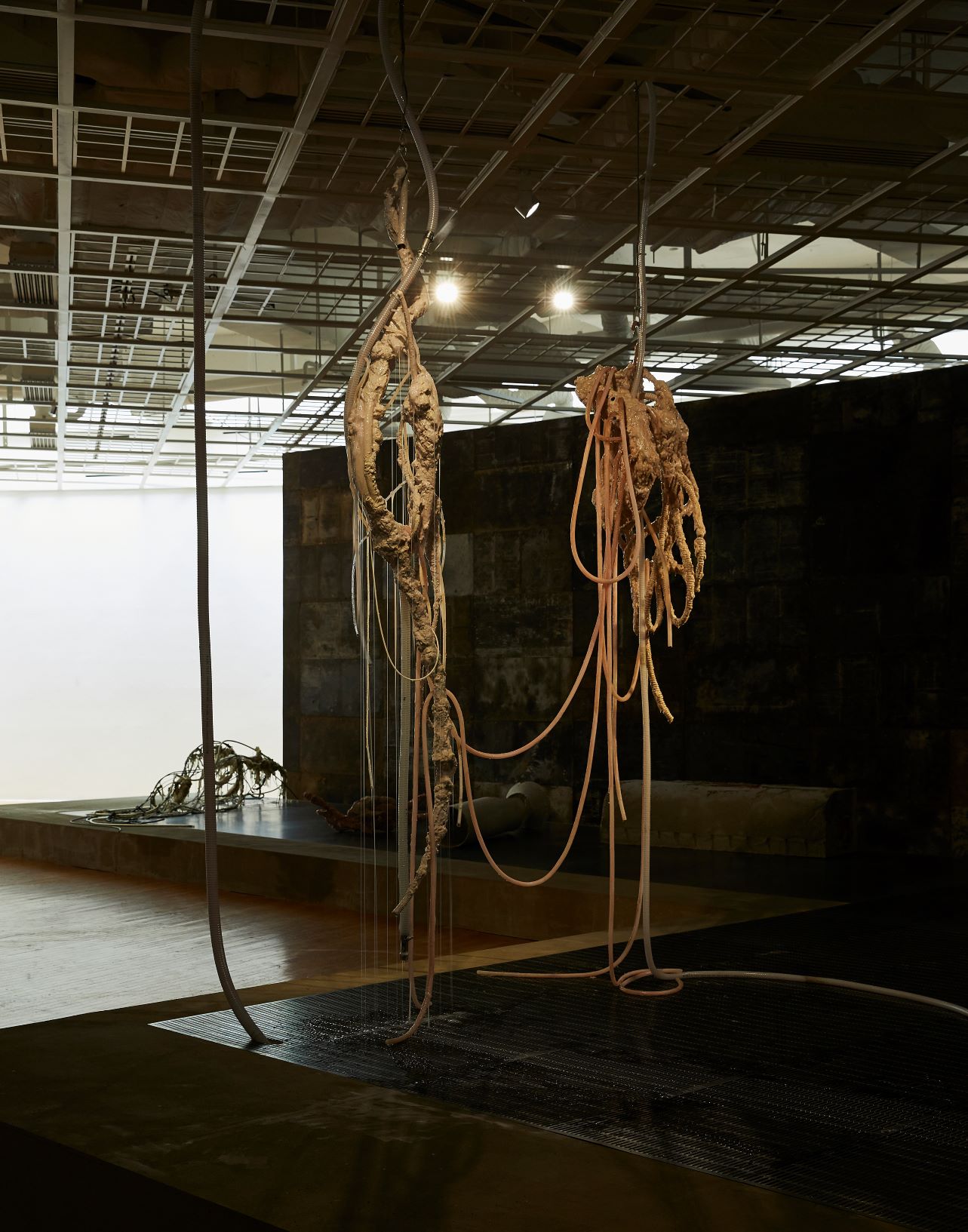
Platform Seoul 2009 Platform in Kimusa (Art Sonje Center and Kimusa, the former Defense Security Command site, Seoul, September 3–25) is held. The project seeks to narrow the gap between art and life and to expand the meaning of public art into architectural projects. Site-specific...
Blossoming Korean Artists in Japan—A Special Collection of Ha Jung-woong (Gwangju Museum of Art, Gwangju, October 11–January 6, 2008) is held. The exhibition features works donated by Ha Jung-woong, a Korean businessman in Japan, and highlights eight artists: Kwak Duckjun, Quac...
The First Seoul International Photography Festival (Insadong, Jongno-gu, Seoul, September 13–26) is held. Chaired by Sung Wan-kyung, the festival consists of the main exhibition Ultra Sense, special exhibitions, and public programs. Thirty Korean and international artists participate,...
The Sixth Gwangju Biennale Fever Variations (Gwangju Biennale Exhibition Hall and the Jungoe Park Cultural Belt, Gwangju, September 8–November 11) is held. Under the artistic direction of Kim Honghee, the biennale examines the transformations and dynamism of contemporary Asia under...
The Arts Management Support Center is established. It is founded as a private foundation by integrating the Seoul Performing Arts Market Secretariat under the Ministry of Culture and Tourism (now the Ministry of Culture, Sports and Tourism) and the Center for Evaluation of Professional Arts...
Cubism in Asia: Unbounded Dialogues, jointly organized by the National Museum of Contemporary Art, Tokyo National Museum of Modern Art, Singapore Art Museum, and the Japan Foundation, is held. The exhibition presents one hundred thirteen works by seventy-six artists from eleven Asian...
Korean Photography and Realism: Photographers in 1950-1960s (Marronnier Art Center (former Misulhoegwan, now ARKO Art Center), Seoul, November 18-December 2) is held, organized by the National Photographers Association [Minjok Sajinga Hyeobhoe]. Five artists—Kim Hanyong, Son Gymun,...
The Ministry of Culture and Tourism opens the Design Museum (Arts Center, Seocho-gu, Seoul, now the Hangaram Design Museum). The steering committee members are Kang Woohyun, Kim Yeongsun, Kim Jungheun, Min Chulhong, Bae Jinhan, Ahn Sang-Soo, An Jeongeon, and Jung Gukhyeon. For the inaugural...
The First Cheongju International Craft Biennale (Cheongju Arts Center and Sports Complex, Chungcheongbuk-do, September 30–October 31) is held. The organizing committee chair is Na Gijeong, and the curator is Jang Dong-gwang. Under the theme "Hands of Harmony", the Biennale consists...
As the Ministry of Culture, Sports and Tourism designates 1999 as the "Year of Architectural Culture", the National Museum of Contemporary Art, Korea (now MMCA) and the Organizing Committee for the Year of Architectural Culture jointly organize The 100 Years, Architecture of Korea...
The proclamation ceremony for the “The Year of Art ’95” is held at the Sejong Center for the Performing Arts, Seoul, on January 16. Organized by the Ministry of Culture and Sports under the motto “Beautiful Mind, Beautiful Life,” the organizing committee is chaired by...
1993 Whitney Biennial in Seoul (National Museum of Contemporary Art, Gwacheon (now MMCA), July 31-September 8) is held. As the first overseas tour of the Whitney Biennial, founded in 1932, the exhibition is organized under the theme 'Borderline' and presents about one hundred works...
The Korean People’s Artists Federation [Hanguk minjok yesurin chongyeonhap] launches the Academy of Literature and Arts, offering public courses. The first president is Yeom Muwoong, and the planning director is the literary critic Im Hongbae. The academy seeks to share critical approaches and...
Bahc Yiso’s article “Identity of Postmodernism and Korean Art” is featured in the January issue of Wolgan Misool. In this article, Bahc goes beyond an introduction to Western theory and practices to discuss issues of translation, refraction, and indigenization in...
The First Museum (Kwanhoon Gallery, Seoul, February 11-27) is held. A total of seven artists participate, including Kho Nakbeom, Noh Gyeongae, Myeong Hyegyeong, Lee Bul, Jung Seung, Choi Jeonghwa and Hong Sungmin. During a time when the conflict between institutional modernism and...
The Seoul ’86 Performance Installation Festival (Arkosmo Gallery, Seoul, October 11-29) is held. A total of forty-five artists participate, including Kang Yongdae, Kang Yongmeon, Kang Jeongheon, Ko Sangjun, Ko Seunghyu, Ko Hyeonhee, Kim Kwansoo, Kim Namjin, Kim Deokgil,...
The Grand Conference of Debate on National Art (Minjok misul daetoronhoe) (Suyu Academy House, August 17-18) is held. The preparatory committee members include Kang Daechul, Kim Yoon-Soo, Kim Jungheun, Kim Choonil, Moon Youngtae, Park Seokkyu, Park Yongsook, Shin Hakchul, Sung...
The Frontier Festival (Gana Art Center, Kwanhoon Gallery, Growrich Gallery, Dongduk Art Gallery, Lloyd Shin Gallery, Seoghwalang, Gallery YEH, Gallery Yoon, Alliance Française in Seoul, Hanaro Art Gallery, Haesong Gallery, Hu Gallery, August 7-16) is held. Around 350 artists...
Ahead of its opening, the founding exhibition of the Reality Group [Hyeonsil dongin] is canceled due to a report submitted by Seoul National University (SNU) and obstruction by the authorities. The Reality Group is formed by Oh Kyunghwan, Oh Yoon, and Lim Setaek, SNU College of Fine Arts students,...
The Korean Avant Garde Association (AG) is formed. AG is formed by Kwak Hoon, Kim Kulim, Kim Dongkyu, Kim Tchahsup, Kim Han, Park Suk-won, Park Chongbae, Suh Seungwon, Song Burnsoo, Shin Hakchul, Shim Moon-seup, Lee Kun-Yong, Lee Seungjio, Lee Seungtaek, Cho Sungmook, Choi Myoungyoung, and Ha...
The exhibition history of the National Museum of Modern and Contemporary Art, Korea (MMCA) dates back to 1969, when the museum opened in the Gyeongbokgung Art Museum building to host the Eighteenth National Art Exhibition (Gukjeon). It began without a curatorial staff or even a single work in its...
The Birth of Artist of the Year When the National Museum of Modern and Contemporary Art, Korea (MMCA) launched its Artist of the Year program in 1995, the initiative represented more than the introduction of a new exhibition program. It was the result of institutional reform that the national...
Stage 1: Borame Dance Hall The exhibition begins with Borame Dance Hall (2001). Upon entering the gallery, visitors are met by lighting and music for the waltz, cha-cha, tango, and other dances. The walls are filled with images of men and women dancing. “Borame” refers to Borame Park in...
Rural Korea The theme of this exhibition is “our countryside.” Over the past three decades, rural Korea has been weathering the rough waves of industrialization, urbanization, and globalization and undergoing a devastating collapse. Particularly since the 1980s, plummeting government...
Here, you see people. These people seem to be enduring their lives rather than enjoying them. The eyes of some of them do not have pupils so that their expressions are hard to read, but all of them have seemingly blank faces on the surface behind which the burning flames in each mind are gushing out...
Kwak Duckjun was born in Japan. His parents went to Japan during the Joseon Dynasty, which was under Japanese colonial rule, settled in Kyoto and had six children, including him. Although Kwak was born in Japan, he grew up as a Korean. It is an irony to which he was destined that he perceived Korea...
I It has been 16 years since the exhibition of Artist of the Year started. The National Museum of Contemporary Art, Korea (now MMCA) had already been holding the Special Exhibition for Senior Artists and Artist of the Month.1 As part of the museum’s efforts to revamp both exhibitions, the...
Artist of the Year 2006 ― Chung Hyun Sculptor Chung Hyun has been selected as ‘Artist of the Year 2006.’ Established in 1995, the ‘Artist of the Year’ award is given annually to the artist who has shown the most outstanding activity in the Korean art world. Selected by...
After the Liberation from Japanese occupation, he attended the newly established Art Department at Seoul National University. He states that he was taught art and its concepts by his “one and only teacher,” Geunwon Kim Yong-Joon (1904-1967). He became a professor there as soon as he...
In 2002, during the height of the World Cup frenzy, the National Museum of Contemporary Art, Korea (now MMCA) awarded Artist of the Year to its first architect, Seung H-Sang. Prior to this, the NMCA had drawn public attention through exhibitions such as Architect Kim Sooguen (1990), Ando Tadao...
This year is the first year of the 21st century, attracting people with a curious sense of hope and excitement. Although our everyday lives have not changed significantly, the enthusiasm was really great at the beginning of the year. We had to put some significance on something new and also were...
Artist of the Year—Kwon Youngwoo An interest in our own and the pursuit for the new possess contrasting values, thus, seeking these goals simultaneously could be an excessive desire to grasp both at once. However, we, stepping on the threshold of the twenty-first century, encounter the...
Organizing the Exhibition for Artist of the Year: Jheon Soocheon Artist Jheon Soocheon has been invited to show at the Artist of the Year exhibition because he satisfies the criteria that this special exhibition is committed to. Transcending genre, age and academic and professional backgrounds,...
1. Newly Emergent Artist Groups of 1957 and Collective Art Movements On April 9, 1957, the first exhibition of the Modern Art Association was held at the Donghwa Gallery. Founded with the stated aim of addressing “the problem of contemporary painting” and positioning itself as an...
I. Introduction In the late 1950s, the Korean art world was in search of a new identity in the wake of liberation and the devastation of war. The government-sponsored exhibition system, inherited from the Joseon Art Exhibition under Japanese colonial rule, was reorganized aer independence as the...
Won Dong suk Professor, Mokpo National University New Currents in 1980s Art —Beyond the Art of the 1970s 1 The currents of Korean art in the 1980s emerged from a movement that sought to understand life in its totality, and from this foundation they generated a powerful and far-reaching...
Lim Dae Geun Traces of Being and Expanded Possibilities: The Last 20 Years of Contemporary Korean Printmaking Source: Exhibition catalogue of Korean Contemporary Prints: A Reflection of a Culture, 37–47. (National Chalcography, The Royal Academy of Fine Arts, Madrid, Spain,...
Lim Geun-jun (a.k.a. Lee Chungwoo) Contemporaneity and Generational Shifts in Korean Contemporary Art: 1987–20081, 2 When did contemporary art first emerge in South Korea, and when did the foundation for its driving force—contemporaneity—begin to take shape? Is it valid to adopt...
Lee Yil Thinking White? It has been not long since contemporary Korean art was introduced to Japan. The first exhibition of modern Korean art in Japan which reflected the general situation and broad aspects of recent trends was the one held in 1968 at the Kyoto National Museum of Modern Art under...
Lee Yil Contemporary Art as an Art of Participation Rather than of Resistance The dazzling outpouring of vitality—referred to as “Hot Abstraction” or “Lyrical Abstraction”—entered a critical juncture in the 1960s, confronting history with its summation....
yeoseong misul based on 1970s feminist art in the United States. They argued that Korean yeoseong misul is a manifestation of feminism itself, which opposed the male-dominated culture, and asserted that it is an independent feminist art that cannot be confined to concepts like...
The Cultural Exhibition in Commemoration of Korean Liberation was held from August 12 through 17, 1946 at the Dong Hwa Gallery with the participation of twenty-four organizations under the Korea Federation of Cultural Organizations [Joseon munhwa danche chong yeonmaeng] in celebration of...
War Documentation Art Exhibition was the third exhibition of the war correspondent painters, who were part of the Ministry of Defense during the Korean War. It was held from September 28 to October 4, 1951 at the former diplomatic club building in the provisional wartime capital of Busan....
Zeitgeist Korea was one of five special exhibitions held from November 12, 2013 to April 27, 2014 to mark the opening of the MMCA, Seoul. Curated by Jung Young-mok, a professor at Seoul National University's College of Fine Arts, the exhibition categorizes the zeitgeist of Korean...
Alchemy of Daily Life was an exhibition held from April 24 to June 27 in 2004 in Gallery 2 of the National Museum of Contemporary Art, Korea (now MMCA). In the exhibition's preface, Kim Kyung-woon, the curator of the exhibition at the MMCA, said that "alchemy" is the process...
Cubism in Asia: Unbounded Dialogues was a touring exhibition co-organized by the National Museum of Contemporary Art, Korea (now MMCA); the Japan Foundation; the National Museum of Modern Art, Tokyo; and the Singapore Art Museum, and held in Japan, Korea, and Singapore between 2005 and...
100 Years of Korean Art was a special exhibition held at the National Museum of Contemporary Art, Korea (now MMCA) to commemorate the sixtieth anniversary of Korea's independence. It offered an overview of Korean art from 1905 to 2005 in two parts. Art historian Kim Hyunsook...
The Korean Applied Artists Association [Hanguk eungyong misulga hyeophoe; KAAA] is a private crafts and design organization formed by members primarily from the Department of Applied Arts at Seoul National University. It was founded in February 1960 and held two exhibitions in 1961 and 1964. Its...
The Asian Art Show, Fukuoka was an international exhibition held every four to five years from 1980 through 1994 at Fukuoka Art Museum in Japan to introduce modern and contemporary art from Asia. The first edition of the exhibition presented 417 works by 417 artists and was divided into two...
Young Minds was a special exhibition organized from 1982 through 1987 by artists in small groups who were active in the 1980s with the goal of showcasing the new aesthetics of the younger generation. The Young Minds [Jeolmeun uisik], which was also the title of its exhibition, had the...
What Is the Realistic Painting of the Postwar Generation? is an exhibition on hyper-realist paintings held from March 16 through 22, 1978 at Art Center. Five young artists born between 1950 and 1954, Moon Youngtae, Song Gamun, Lee Sukju, Rhee Jaikwon, and Jo Sang-hyeon, participated in the...
The Seoul Contemporary Art Festival was a large-scale art festival held since 1975 by avant-garde artists of the time to counter the academism of the National Art Exhibition (Gukjeon). The first festival was held from December 16 through 22, 1975 at the National Museum of Modern Art, Korea...
Artists in Focus was the title of a series of exhibition held by Seoul Museum from 1982 through 1989. In November 1981, the Seoul Museum opened on the first floor of the former Belgium Embassy in Gugi-dong, Jongno-gu, Seoul. The art critic Kim Yoon-Soo served as its first director. The...
Exhibition of Gusangjeon is the name of regular exhibitions held by the Gusanghoe, an organization of Western-style painters established in September 1967. The Gusanghoe was formed with the aim of “eliminating the misconception that abstraction is more advanced than figuration in art...
The March First Independence Movement Day Celebration Art Exhibition was co-hosted by the Korean Federation of Cultural Organizations [Jeonguk munhwa danche chongyeonhapoe; KFCO] and the Great Korean Art Association [Daehan misul hyeophoe] to celebrate and commemorate the March First...
The Korean Project was one of several U.S. technology sponsorship programs implemented in the late 1950s through the International Cooperation Administration (ICA) under the U.S. Department of State. Its undertaker was Smith, Scherr & McDermott Industrial Design (SSM), whose headquarters was...
Color painting, or chaesaekhwa in Korean, is a term that began to be widely used from the mid-1970s to refer to traditional and contemporary Eastern painting produced primarily with colors. Eastern painting, which was established as a modern painting genre during the Japanese colonial era,...
Hoengdan was the name of an art group which was active only briefly from 1980 to 1983, and it was also the theme of their exhibition. Its establishment started from a reflection on Korean contemporary art in the 1970s, by artists who believed that art cannot turn a blind eye to social reality. The...
POINT was the first small Minjung art collective active in Suwon from 1979 to 1985. It was founded by holding the exhibition POINT-79 of Baek Jonggwang, Chang Younggook, and Choi Choonil in December 1979 at the third-floor exhibition hall of Croba Department Store. In its second exhibition...
Choi Wook-kyung (1940-1985) graduated from the Department of Painting at Seoul National University and studied at the Cranbrook Academy of Art and the Brooklyn Museum Art School in the U.S. While studying abroad, Choi embraced a wide range of contemporary American art movements, including Abstract...
Kang Min-gi, 1945–1953: Independence and “National Art” (Minjok Misul)
Kwon Heangga, 1953-1959: The Post-war Formation of Contemporary Art
Cho Soojin, 1960–1969: Avant-garde Activities and Development of the Art System
Kim Yisoon, 1970-1979: Transformation of the Art World and the Growth of “Korean” Art
Lim Shan, 1980–1989: Expanding Art Practices and the Narrative of the Times
Shin Chunghoon, 1990-1999: Korean Contemporary Art in Globalization
Cho Soojin, Kang Min-gi, Kim Yisoon, Kwon Heangga, Lim Shan, Shin Chunghoon, On Writing Timelines of Korean Art: The Roundtable
Cho Soojin, Kang Min-gi, Kim Yisoon, Kwon Heangga, Lim Shan, Shin Chunghoon, Study Group 1 │ On Writing Timelines of Korean Art: The Keyword
Hur Hojeong, The Curator’s Dilemma
Hur Hojeong, The Title of “Feminist Artists” and “Feminist Art”
Hur Hojeong, The Methodology of Questioning
Lee Jinshil, Bone and Wrapper: Moving Body Fragments
Lee Jinshil, Fishy Paintings: The Tentacular Sensibilities of Women Painters
Lee Jinshil, Labor and the Woman’s Body as a Battleground of Emotion
siren eun young jung, What Does Feminist Art/Artist Do? (1)
siren eun young jung, What Does Feminist Art/Artist Do? (2)
siren eun young jung, What Does Feminist Art/Artists Do? (3)
Kim Hyeonjoo, An Overview of South Korean Feminist Art
Kim Hyeonjoo, Traversing South Korea and the United States - Diaspora Women Artists Theresa Hak Kyung Cha and Yong Soon Min
Kim Hyeonjoo, Time to study Noh Wonhee
Hur Hojeong, siren eun young jung, Kim Hyeonjoo, Lee Jinshil, Contemporary Art and Feminism (Study Group 1 Roundtable)
Kim Hyeonjoo, An Overview of South Korean Feminist Art (Study Group 1 Presentation)