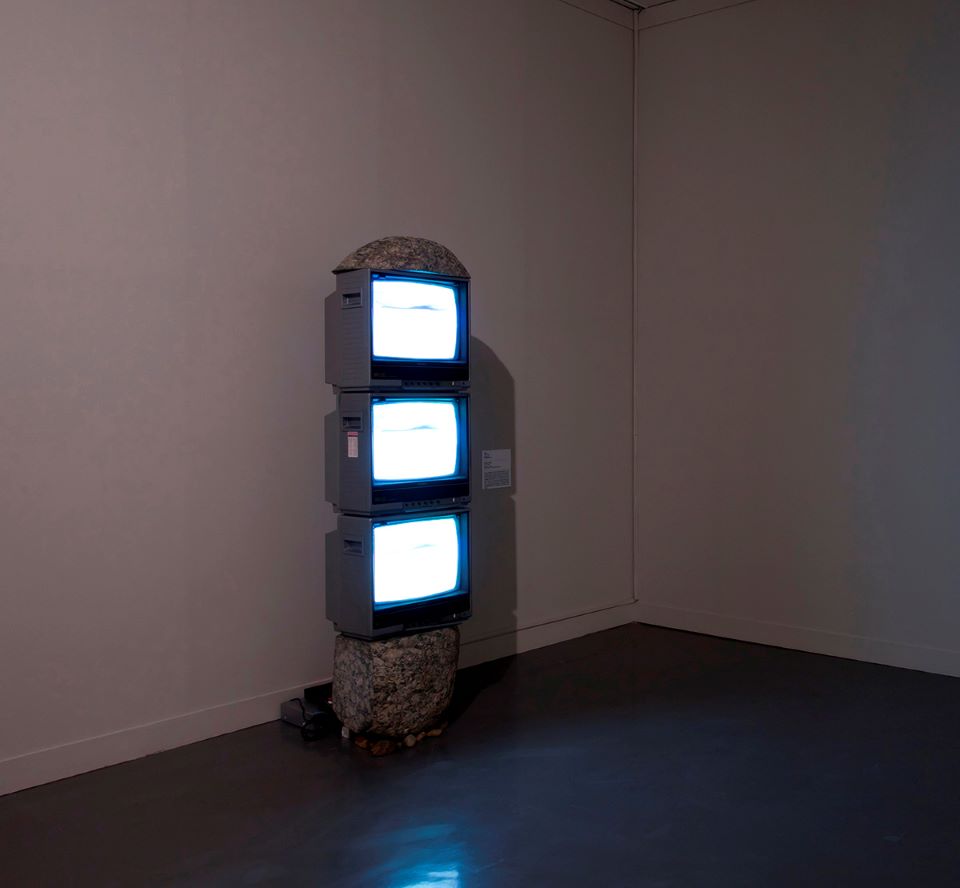
Park Hyunki, Untitled, 1986, TV, stone, videotape, 207×51×46cm. MMCA collection
Media art


* Source: Multilingual Glossary of Korean Art. Korea Arts Management Service
Related
-

Video art
A genre of modern art that uses video as a medium. After Paik Nam June created the first works of video art in 1963, the genre spread internationally. Video art explored new artistic possibilities using advanced technology and embodied a rejection of conventional art media. Video art was quick to drawn critical attention because of the relative immediacy that underlies the creation and display of such works, and the efficiency of the medium as means to portray and interlink a large number of images. Following Paik Nam June ’s early experiments with TV monitor installations in the 1960s, in the 1970s new forms of work emerged that combined video and performance art.
-
Media Theory Research Society
The Media Theory Research Society (Maeche iron yeonguhoe, MTRS) was an art organization active from 1992 to 1994 with artists from the Busan area as central figures. It mainly presented media art and installation work using a variety of mediums, hosted academic events to study media aesthetics, and attempted the publication of a specialized art magazine Mook. The origin of the MTRS lied in the Visual Language Research Society that held a symposium on “Diagnosis of Korean Contemporary Art” from January through March in 1992 by inviting critics Choe Beom and Baek Jisuk. The MTRS was founded in April 1992 by its first president Jeon Changrae, Park Eunguk, who was the head of the Visual Language Research Society, and Kim Jonghwa, the editor-in-chief of the magazine Art & Criticism (Misulgwa bipyeong). Its key members include Sim Junseop, Lee Sangjin, Kim Yeonghee, Jo Sunok, Chae Seunghui, Lee Jungja, Lee Jeonghui, Park Changwon, Yim Yeongsil, Park Bongrae, Choe Yunjeong, Kim Gapsu, and Kang Juwan. In 1993 and 1994, the MTRS organized the second and third Korean Contemporary Art symposiums to provide an opportunity to discuss academic presentations, theoretical research, and the development of art in Busan. In July 1993, it prepared the preliminary issue of the Art & Criticism magazine as an attempt to launch the first art magazine in Busan, but it was never officially published. The MTRS was a project-type group in which artists participated according to exhibition themes. Among its special exhibitions is Scene 051: The Dream of a Colorful City held in 1992 at Dada Gallery in Busan. It also participated in group exhibitions in Seoul, including Art and Reflection (Kumho Museum of Art, 1992) curated by Park Chan-kyong and Baek Jisuk and FRONT DMZ (Seoul Museum of Art, 1993) hosted by the Demilitarized Zone Arts and Cultural Movement Council. The activities of the MTRS in the early 1990s brought intensive attention to media art for the first time in the history of art in Busan and directly impacted the activities of Busan media art small groups that began to emerge in the late 1990s. These small groups include DigiArt-Animation Studio (founded in 1995), MEDIUM (founded in 1998), PIXEL (founded in 1998), INOUT (founded in 1999), format (founded in 1999), and C.O.D.E. (founded in 1999).
-
Technology art
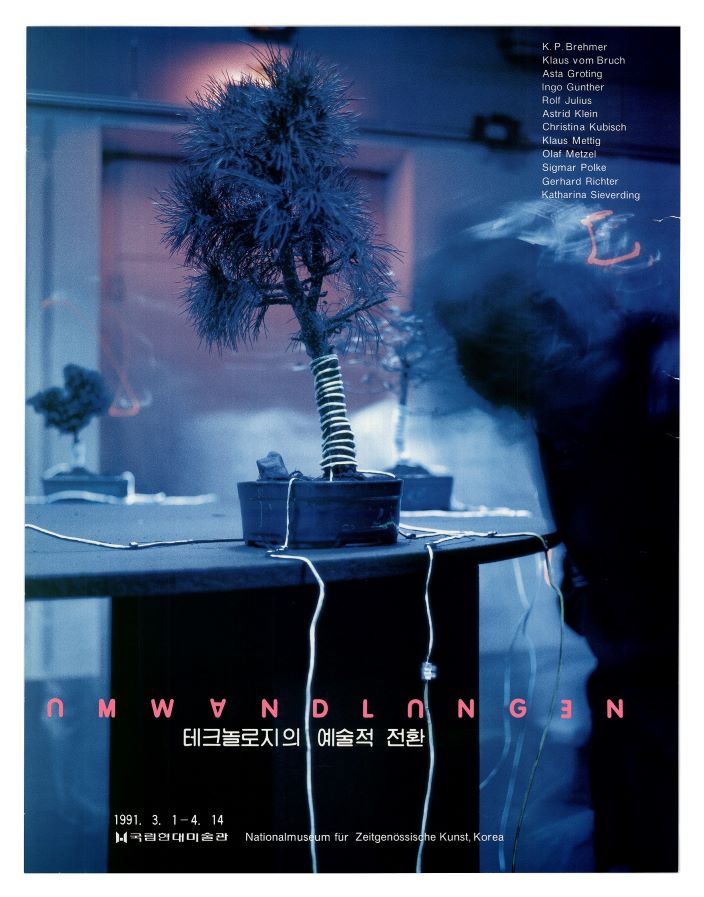
The convergence of, or the attempts to fuse, art and science, which particularly arose as advances in scientific technology after World War II inspired artistic creation. Cybernetics and system theory, based on idealist thinking that emerged in the 1960s, and held that “scientific technology will accelerate human progress”, greatly influenced the creation of art based on modern technology. Later, this interest would expand into the realms of internet art, laser art, and holographic art. Toward the later 1970s, technological approaches to art merged with popular art, which led to the development of video games, cyberpunk novels, techno music, and deconstructionist graphic design. In Korea, Kang Kukjin’s 1967 work combining neon and stainless steel and AG group’s Kwak Hoon’s optical installation using electronics in his solo exhibition at Shinmoon Center in 1968 are representative works of early Korean digital art. In 1976, Kim Soungui videotaped his performance during his stay in Paris, and Park Hyunki and Lee Kangso submitted digital technology works to the Daegu Contemporary Art Festival in the mid-1970s.
Timelines

Sign Up for Email Updates