1. Charles Green and Anthony Gardner, Biennials, Triennials, and documenta: The Exhibitions that Created Contemporary Art (Chichester: Wiley Blackwell, 2016).
2. René Block, “We Hop On, We Hop Off: The Ever-faster Spinning Carousel of Biennials,” in Shifting Gravity, ed. Ute Meta Bauer and Hou Hanru (Berlin: Hatje Cantz, 2014), 104-109. This text by René Block was presented at the First World Biennale Forum, organized by the Gwangju Biennale in 2012.
3. Lee Joon, “Cultural Politics in Korean Art Regime and Exhibition—Focus of the Gwangju Biennale—,” Journal of Basic Design & Art 12, no. 4 (2011): 297.
4. Gwangju Biennale Secretariat, The first Gwangju Biennale Master Plan (Gwangju: Gwangju Biennale Foundation, 1995), 181. Given that the final report of the inaugural Gwangju Biennale lacks specific budget execution data, the budget plan has been used as a reference point.
5. “Gwangju Biennale Founding Manifesto,” Ibid., 9. The manifesto was jointly written by Lim Youngbang, Jang Seokwon, and Lee Yongwoo, and was adopted on February 10, 1995.
6. Ibid., 9.
7. The civilian government prioritized enhancing Korea’s global standing, achieving successful bids for the Korea–Japan World Cup 2002 and the Busan Asian Games 2002, and also joined the OECD in 1996.
8. Kim Yundeok, “People Kim Yundeok Met: Lee Yongwoo—A Leading Figure of 30 Years of the Korean Pavilion at the Venice Biennale and the Gwangju Biennale,” Chosun Ilbo, June 22, 2025, https://www.chosun.com/opinion/2025/06/22/O54VLWIAQBGGVII74JJPDI3ZEU/.
9. Gwangju Biennale Secretariat, The First Gwangju Biennale Final Report (Gwangju: Gwangju Biennale Foundation, 1995), 9.
10. Ibid.
11. The First Gwangju Biennale Master Plan (Gwangju: Gwangju Biennale Foundation, 1995), 8.
12. Jang Seokwon, Jo Kwang Suk, Ra Wonsik, Seo Seong-rok, Yi Seung-yeong. “Reflections and Achievements of the Gwangju Biennale,” Misul Segye, no. 133 (December 1995): 67.
13. Ibid., 69.
14. Lee Yongwoo, “Restructuring Boundaries,” in 95 Gwangju Biennale: Beyond the Borders, Exhibition Catalogue (Seoul: Life and Dream, 1995), 17.
15. Ibid., 16.
16. Ibid.
17. Sung Wan-kyung, “Moving Boundaries,” Ibid., 44.
2. René Block, “We Hop On, We Hop Off: The Ever-faster Spinning Carousel of Biennials,” in Shifting Gravity, ed. Ute Meta Bauer and Hou Hanru (Berlin: Hatje Cantz, 2014), 104-109. This text by René Block was presented at the First World Biennale Forum, organized by the Gwangju Biennale in 2012.
3. Lee Joon, “Cultural Politics in Korean Art Regime and Exhibition—Focus of the Gwangju Biennale—,” Journal of Basic Design & Art 12, no. 4 (2011): 297.
4. Gwangju Biennale Secretariat, The first Gwangju Biennale Master Plan (Gwangju: Gwangju Biennale Foundation, 1995), 181. Given that the final report of the inaugural Gwangju Biennale lacks specific budget execution data, the budget plan has been used as a reference point.
5. “Gwangju Biennale Founding Manifesto,” Ibid., 9. The manifesto was jointly written by Lim Youngbang, Jang Seokwon, and Lee Yongwoo, and was adopted on February 10, 1995.
6. Ibid., 9.
7. The civilian government prioritized enhancing Korea’s global standing, achieving successful bids for the Korea–Japan World Cup 2002 and the Busan Asian Games 2002, and also joined the OECD in 1996.
8. Kim Yundeok, “People Kim Yundeok Met: Lee Yongwoo—A Leading Figure of 30 Years of the Korean Pavilion at the Venice Biennale and the Gwangju Biennale,” Chosun Ilbo, June 22, 2025, https://www.chosun.com/opinion/2025/06/22/O54VLWIAQBGGVII74JJPDI3ZEU/.
9. Gwangju Biennale Secretariat, The First Gwangju Biennale Final Report (Gwangju: Gwangju Biennale Foundation, 1995), 9.
10. Ibid.
11. The First Gwangju Biennale Master Plan (Gwangju: Gwangju Biennale Foundation, 1995), 8.
12. Jang Seokwon, Jo Kwang Suk, Ra Wonsik, Seo Seong-rok, Yi Seung-yeong. “Reflections and Achievements of the Gwangju Biennale,” Misul Segye, no. 133 (December 1995): 67.
13. Ibid., 69.
14. Lee Yongwoo, “Restructuring Boundaries,” in 95 Gwangju Biennale: Beyond the Borders, Exhibition Catalogue (Seoul: Life and Dream, 1995), 17.
15. Ibid., 16.
16. Ibid.
17. Sung Wan-kyung, “Moving Boundaries,” Ibid., 44.
Tiffany Yeon Chae
From a Site of Memory to a Global Platform: The Founding of the Gwangju Biennale and Beyond the Borders (1995)
The development of international biennales can generally be divided into three waves.1 The Venice Biennale, which began in 1895, represents the Eurocentric art system, while Documenta in Kassel, Germany, launched in 1955, developed within the context of postwar Germany and reconstruction. Beginning in the mid-1980s, a new wave of biennales emerged in non-Western contexts, notably in cities such as Gwangju, Havana, Istanbul, and Johannesburg. These biennales reflect the emergence of regions once objectified as the “Third World” as new cultural agents within the broader dynamics of globalization. They have become critical platforms that sharply reflect contemporary culture, characterized by the global movement of people, capital, and information.
Since its establishment in 1995, the Gwangju Biennale has hosted fifteen exhibitions over thirty years, playing a pivotal role in introducing contemporary Korean art to the international stage. It is critical to note that the Gwangju Biennale emerged from Gwangju, a city symbolically associated with the pro-democracy movement and from Asia, a region historically marginalized within the Eurocentric biennale system. In this light, it presented a model that integrated locality and globality, thereby establishing itself as a precedent for non-Western biennales. Therefore, examining the founding context and early development of the Gwangju Biennale not only offers insights into the internal transformations of Korean art but also reveals how art institutions in non-Western regions have been reconfigured within the broader framework of global art history. From this perspective, this study explores the founding and institutional development of the Gwangju Biennale in order to reassess its position and significance within the global art ecosystem.
The Founding of the Gwangju Biennale: From Gwangju to the World
Established in 1995, the Gwangju Biennale quickly rose to prominence as one of the most noteworthy biennials in the world. With substantial state funding, it organized major international exhibitions featuring prominent figures from the global art world, drawing an enormous audience in a short period of time, thereby making a remarkable impact on the global biennale landscape. Notably, the inaugural Gwangju Biennale attracted as many as 1.63 million visitors—an exceptional record, especially when contrasted with the Venice Biennale’s record attendance of 800,000 in 2022, despite its 130-year history. This positions the Gwangju Biennale’s debut as an unprecedented achievement in the history of international biennales.
From its founding to the present, the Gwangju Biennale has relied heavily on public financial support from both the national and local governments. This model differs significantly from the Venice Biennale, which depends on financial contributions from participating countries, or the Sydney Biennale, which is jointly funded by the host and participating nations.2 René Block, who served as co-commissioner for the third Gwangju Biennale in 2000, viewed this structure as a major strength, noting that it afforded the Biennale's board greater autonomy in selecting themes and appointing directors. Moreover, the government's decentralization efforts, marked by a reduction in central administrative control and the full implementation of local self-governance, further contributed to the Biennale’s early success.3 In fact, the inaugural budget reveals that 10.4 billion KRW (approximately 7.5 million USD) accounting for 60 percent of the total 18.2 billion KRW (approximately 13.1 million USD) allocated to exhibition hall construction, was provided by the Gwangju city government.4 Following the success of the Gwangju Biennale, other local governments launched their own biennales in succession, including Seoul Mediacity Biennale (2000), Gyeonggi Ceramics Biennale (2001), and Busan Biennale (2002).
The Gwangju Biennale emerged as a relative latecomer to the global biennale landscape, originating from the geographical and cultural periphery of Asia. However, by intertwining the historical legacy of the May 18 Gwangju Democratization Movement in Korea, with the political and social currents of globalization, it strategically sought to transcend local specificity in favor of broader universality and global resonance. Its founding manifesto, which aspired to create a global community transcending nation, ethnicity, ideology, and religion, articulates the Biennale’s intention to establish itself not merely as a national art event, but as a significant platform for international cultural discourse. “The People of Gwangju respect the diversity and uniqueness of cultures around the world, and seek balance between the East and West. They hope to see the creation of a lively pan-Asian culture for the 21st century, the Pacific Age.”5 Furthermore, the manifesto emphasized that Gwangju, historically renowned for its artistic traditions, would actively embrace new paradigms such as information technology. “Using art’s ability to condense and to adapt, the Gwangju Biennale will pursue globalization rather than westernization; diversity rather than uniformity. Art should be flexible enough to act as an index for the future and a reflection of present realities, yet be rich and mature enough to maintain traditional values in our lives and thinking. The latest developments in science and technology can collaborate with tradition in this process, and ultimately guide us in our pursuit of a new consciousness grounded in freedom and imagination.”6
The civilian government of President Kim Young-sam designated 1995 as the “Year of Art,” signalling a proactive stance on art and cultural policy. This followed South Korea’s successful hosting of the 1988 Seoul Olympics and the 1993 Daejeon Expo, which showcased the country’s development and technological advancement to the world.7 Since the 1960s, South Korea had actively participated in overseas biennales such as the São Paulo and Paris Biennales, fully recognizing the symbolic significance of international exhibitions. In 1993, Korean artist Paik Nam June won the Golden Lion at the Venice Biennale for representing the German Pavilion, and the inauguration of the Korean Pavilion at the Venice Biennale was scheduled for 1995. In 1995, designated as the Year of Art and marking the fiftieth anniversary of Korea’s liberation, calls from the art community to establish an international biennale in Korea began to gain momentum.
Established sculptor Kim Youngjung, who was based in Gwangju, proposed that hosting a biennale in Gwangju, a city still bearing the trauma of the Gwangju Democratization Movement, could serve as a catalyst for healing through art. The proposal gained the support of then-Mayor Kang Woon-tae, and with the involvement of art professionals such as Lee Yongwoo, discussions between the central government and the city of Gwangju regarding the establishment of the Gwangju Biennale began to take shape.8 A preliminary planning team was formed on September 28, 1994, followed by the mayor’s official announcement of the biennale project on November 14. On December 6, the inaugural organizing committee was formed, comprising fifty-three members that included officials from the central government and the city of Gwangju, journalists, scholars, critics, and artists. On January 27, 1995, President Kim visited Gwangju and pledged full support at the central government level, stating that the Biennale represented “a decisive opportunity to showcase Gwangju to the world” and “an important stepping stone toward globalization.”11
Meanwhile, Paik Nam June played a significant role in bringing major international curators and artists to participate in the inaugural Gwangju Biennale. It was Paik who first proposed the co-commissioner model for the main exhibition, structured around the concept of “five oceans, six continents.” He was also deeply involved in organizing the exhibition of 1993 Whitney Biennial in Seoul at the National Museum of Contemporary Art (now MMCA) of Korea, as well as the establishment of the Korean Pavilion at the Venice Biennale in 1995. For the inaugural Gwangju Biennale, he co-curated the special exhibition InfoART with Cynthia Goodman and Kim Hong-hee. In the exhibition, he presented Dolmen, an experimental large-scale installation that combined television monitors, Korean jangdokdae—platforms for storing earthenware crocks of sauces and condiments—and video art. On the eve of the opening, he also staged a “video opera,” an experimental blend of piano performance and video art.
Beyond the Borders (1995): A Suggestion for global harmony
The inaugural Gwangju Biennale was held over sixty-two days, from September 20 to November 20, 1995. It was a large-scale international exhibition featuring the main exhibition and six special exhibitions, with over 660 artists from fifty-eight participating countries. On the opening day, a banner proclaiming “To Gwangju, to the World” stretched across Geumnam-ro Street in Gwangju. Throughout the exhibition, more than 2,200 members of ethnic performing troupes from thirty countries took part in parades and live performances. That street, once marked by the brutal loss of many lives, was transformed into a vibrant stage for an integrated arts festival, uniting Gwangju’s citizens, artists, and visitors alike.
The main theme of the exhibition was “Beyond the Borders,” aiming to transcend all existing boundaries—political, cultural, religious, and geographical—in pursuit of global unity. The exhibition was divided into six regions—Europe, Asia, the Americas, Oceania, the Middle East, and Africa—each curated by one of seven commissioners: You Hongjune, Oh Kwang-su, Sung Wan-kyung, Kathy Halbreich, Jean de Loisy, Anda Rottenberg, and Clive Adams. Works in each section addressed themes of borders, identity, and the sociopolitical conditions of each region. Importantly, the Cuban artist Kcho’s installation To Forget depicted the dire reality faced by refugees and was awarded the Grand Prize of the biennale. Korean artists Hong Sungdam and Kim Jungheun presented realist works rooted in the Minjung art tradition, while critically engaging with the political climate of the 1980s. Among the six special exhibitions, the most prominent was InfoART, co-curated by Paik Nam June, Cynthia Goodman, and Kim Hong-hee. The exhibition examined the interplay between viewer, machine, and artwork through video and computer interfaces, envisioning the role of art in the digital era.
Let us consider how art professionals at the time assessed the Gwangju Biennale. Jang Seokwon, former Deputy Executive Director, observed that a key factor in the success of the Gwangju Biennale was its collaborative framework, which integrated the efforts of local government officials, organizing and executive committees, and art experts from both Korea and abroad.12 Art critic Seo Seong-rok emphasized that the biennale revitalized stagnant regional cultural activities, while proposing a new cultural paradigm centered on the Asia-Pacific region. It broke away from the conventional “lodger-like” model of participation in international exhibitions, instead establishing an autonomous platform for global art discourse.13 Lee Yongwoo, who served as the chief of the curatorial team and later as the biennale’s president, highlighted that the inaugural exhibitions were conceived as a critical response to the aesthetic disorder proliferating under the name of “pluralism” and sought to examine the underlying substance of cultural boundaries.14
The first Gwangju Biennale was held at a time when postmodernism, pluralism, and postcolonial discourses in art were dominant both in Korea and abroad. In this context, the activities undertaken two years earlier by three key figures in the exhibition’s planning—Lim Youngbang, then Director of the MMCA; Paik Nam June; and Lee Yongwoo—are particularly noteworthy. One of the activities was hosting the exhibition of 1993 Whitney Biennial in Seoul, a Korean adaptation of the exhibition originally held at the Whitney Museum of American Art in the United States. This project was initiated by Director Lim Youngbang, with Paik Nam June and Lee Yongwoo providing financial backing and operational support, respectively. Through the theme “borderline,” the exhibition addressed critical issues in American society such as race, gender, and class conflict. By employing a genre-defying format that merged video art and installation, it provoked a profound “cultural shock” among Korean audiences. Given this context, it can be inferred that these figures, central to the introduction of postmodern discourse in Korea, made new attempts through Beyond the Borders to articulate a distinctively Korean formulation of postcolonial discourse.
Meanwhile, Lee Yongwoo underscores the significance of Minjung art in contemporary Korean art, attributing its philosophical foundation to the civic spirit of Gwangju—the epicenter of the May 18 Democratization Movement in 1980.15 This “Gwangju spirit,” he argues, serves as a catalyst for cultivating citizens’ autonomous cultural consciousness and as a foundation for embracing the pluralistic themes of contemporary art.16 Sung Wan-kyung, who served as commissioner for the Latin American section in the inaugural Gwangju Biennale, further contends that the Biennale is a cultural movement with collective influence in the Third World context. He draws parallels with Latin American conceptual art, particularly in its attempts to translate utopian ideals into social and cultural experience.17 Over the past three decades, the Gwangju Biennale has continuously reinterpreted the legacy of the May 18 Gwangju Democratization Movement, thoughtfully engaging with the social function and responsibility of art. Through this commitment, it appears to have securely positioned itself as an integral part of the international exhibition system.

Since its establishment in 1995, the Gwangju Biennale has hosted fifteen exhibitions over thirty years, playing a pivotal role in introducing contemporary Korean art to the international stage. It is critical to note that the Gwangju Biennale emerged from Gwangju, a city symbolically associated with the pro-democracy movement and from Asia, a region historically marginalized within the Eurocentric biennale system. In this light, it presented a model that integrated locality and globality, thereby establishing itself as a precedent for non-Western biennales. Therefore, examining the founding context and early development of the Gwangju Biennale not only offers insights into the internal transformations of Korean art but also reveals how art institutions in non-Western regions have been reconfigured within the broader framework of global art history. From this perspective, this study explores the founding and institutional development of the Gwangju Biennale in order to reassess its position and significance within the global art ecosystem.
The Founding of the Gwangju Biennale: From Gwangju to the World
Established in 1995, the Gwangju Biennale quickly rose to prominence as one of the most noteworthy biennials in the world. With substantial state funding, it organized major international exhibitions featuring prominent figures from the global art world, drawing an enormous audience in a short period of time, thereby making a remarkable impact on the global biennale landscape. Notably, the inaugural Gwangju Biennale attracted as many as 1.63 million visitors—an exceptional record, especially when contrasted with the Venice Biennale’s record attendance of 800,000 in 2022, despite its 130-year history. This positions the Gwangju Biennale’s debut as an unprecedented achievement in the history of international biennales.
From its founding to the present, the Gwangju Biennale has relied heavily on public financial support from both the national and local governments. This model differs significantly from the Venice Biennale, which depends on financial contributions from participating countries, or the Sydney Biennale, which is jointly funded by the host and participating nations.2 René Block, who served as co-commissioner for the third Gwangju Biennale in 2000, viewed this structure as a major strength, noting that it afforded the Biennale's board greater autonomy in selecting themes and appointing directors. Moreover, the government's decentralization efforts, marked by a reduction in central administrative control and the full implementation of local self-governance, further contributed to the Biennale’s early success.3 In fact, the inaugural budget reveals that 10.4 billion KRW (approximately 7.5 million USD) accounting for 60 percent of the total 18.2 billion KRW (approximately 13.1 million USD) allocated to exhibition hall construction, was provided by the Gwangju city government.4 Following the success of the Gwangju Biennale, other local governments launched their own biennales in succession, including Seoul Mediacity Biennale (2000), Gyeonggi Ceramics Biennale (2001), and Busan Biennale (2002).
The Gwangju Biennale emerged as a relative latecomer to the global biennale landscape, originating from the geographical and cultural periphery of Asia. However, by intertwining the historical legacy of the May 18 Gwangju Democratization Movement in Korea, with the political and social currents of globalization, it strategically sought to transcend local specificity in favor of broader universality and global resonance. Its founding manifesto, which aspired to create a global community transcending nation, ethnicity, ideology, and religion, articulates the Biennale’s intention to establish itself not merely as a national art event, but as a significant platform for international cultural discourse. “The People of Gwangju respect the diversity and uniqueness of cultures around the world, and seek balance between the East and West. They hope to see the creation of a lively pan-Asian culture for the 21st century, the Pacific Age.”5 Furthermore, the manifesto emphasized that Gwangju, historically renowned for its artistic traditions, would actively embrace new paradigms such as information technology. “Using art’s ability to condense and to adapt, the Gwangju Biennale will pursue globalization rather than westernization; diversity rather than uniformity. Art should be flexible enough to act as an index for the future and a reflection of present realities, yet be rich and mature enough to maintain traditional values in our lives and thinking. The latest developments in science and technology can collaborate with tradition in this process, and ultimately guide us in our pursuit of a new consciousness grounded in freedom and imagination.”6
The civilian government of President Kim Young-sam designated 1995 as the “Year of Art,” signalling a proactive stance on art and cultural policy. This followed South Korea’s successful hosting of the 1988 Seoul Olympics and the 1993 Daejeon Expo, which showcased the country’s development and technological advancement to the world.7 Since the 1960s, South Korea had actively participated in overseas biennales such as the São Paulo and Paris Biennales, fully recognizing the symbolic significance of international exhibitions. In 1993, Korean artist Paik Nam June won the Golden Lion at the Venice Biennale for representing the German Pavilion, and the inauguration of the Korean Pavilion at the Venice Biennale was scheduled for 1995. In 1995, designated as the Year of Art and marking the fiftieth anniversary of Korea’s liberation, calls from the art community to establish an international biennale in Korea began to gain momentum.
Established sculptor Kim Youngjung, who was based in Gwangju, proposed that hosting a biennale in Gwangju, a city still bearing the trauma of the Gwangju Democratization Movement, could serve as a catalyst for healing through art. The proposal gained the support of then-Mayor Kang Woon-tae, and with the involvement of art professionals such as Lee Yongwoo, discussions between the central government and the city of Gwangju regarding the establishment of the Gwangju Biennale began to take shape.8 A preliminary planning team was formed on September 28, 1994, followed by the mayor’s official announcement of the biennale project on November 14. On December 6, the inaugural organizing committee was formed, comprising fifty-three members that included officials from the central government and the city of Gwangju, journalists, scholars, critics, and artists. On January 27, 1995, President Kim visited Gwangju and pledged full support at the central government level, stating that the Biennale represented “a decisive opportunity to showcase Gwangju to the world” and “an important stepping stone toward globalization.”11
Meanwhile, Paik Nam June played a significant role in bringing major international curators and artists to participate in the inaugural Gwangju Biennale. It was Paik who first proposed the co-commissioner model for the main exhibition, structured around the concept of “five oceans, six continents.” He was also deeply involved in organizing the exhibition of 1993 Whitney Biennial in Seoul at the National Museum of Contemporary Art (now MMCA) of Korea, as well as the establishment of the Korean Pavilion at the Venice Biennale in 1995. For the inaugural Gwangju Biennale, he co-curated the special exhibition InfoART with Cynthia Goodman and Kim Hong-hee. In the exhibition, he presented Dolmen, an experimental large-scale installation that combined television monitors, Korean jangdokdae—platforms for storing earthenware crocks of sauces and condiments—and video art. On the eve of the opening, he also staged a “video opera,” an experimental blend of piano performance and video art.
Beyond the Borders (1995): A Suggestion for global harmony
The inaugural Gwangju Biennale was held over sixty-two days, from September 20 to November 20, 1995. It was a large-scale international exhibition featuring the main exhibition and six special exhibitions, with over 660 artists from fifty-eight participating countries. On the opening day, a banner proclaiming “To Gwangju, to the World” stretched across Geumnam-ro Street in Gwangju. Throughout the exhibition, more than 2,200 members of ethnic performing troupes from thirty countries took part in parades and live performances. That street, once marked by the brutal loss of many lives, was transformed into a vibrant stage for an integrated arts festival, uniting Gwangju’s citizens, artists, and visitors alike.
The main theme of the exhibition was “Beyond the Borders,” aiming to transcend all existing boundaries—political, cultural, religious, and geographical—in pursuit of global unity. The exhibition was divided into six regions—Europe, Asia, the Americas, Oceania, the Middle East, and Africa—each curated by one of seven commissioners: You Hongjune, Oh Kwang-su, Sung Wan-kyung, Kathy Halbreich, Jean de Loisy, Anda Rottenberg, and Clive Adams. Works in each section addressed themes of borders, identity, and the sociopolitical conditions of each region. Importantly, the Cuban artist Kcho’s installation To Forget depicted the dire reality faced by refugees and was awarded the Grand Prize of the biennale. Korean artists Hong Sungdam and Kim Jungheun presented realist works rooted in the Minjung art tradition, while critically engaging with the political climate of the 1980s. Among the six special exhibitions, the most prominent was InfoART, co-curated by Paik Nam June, Cynthia Goodman, and Kim Hong-hee. The exhibition examined the interplay between viewer, machine, and artwork through video and computer interfaces, envisioning the role of art in the digital era.
Let us consider how art professionals at the time assessed the Gwangju Biennale. Jang Seokwon, former Deputy Executive Director, observed that a key factor in the success of the Gwangju Biennale was its collaborative framework, which integrated the efforts of local government officials, organizing and executive committees, and art experts from both Korea and abroad.12 Art critic Seo Seong-rok emphasized that the biennale revitalized stagnant regional cultural activities, while proposing a new cultural paradigm centered on the Asia-Pacific region. It broke away from the conventional “lodger-like” model of participation in international exhibitions, instead establishing an autonomous platform for global art discourse.13 Lee Yongwoo, who served as the chief of the curatorial team and later as the biennale’s president, highlighted that the inaugural exhibitions were conceived as a critical response to the aesthetic disorder proliferating under the name of “pluralism” and sought to examine the underlying substance of cultural boundaries.14
The first Gwangju Biennale was held at a time when postmodernism, pluralism, and postcolonial discourses in art were dominant both in Korea and abroad. In this context, the activities undertaken two years earlier by three key figures in the exhibition’s planning—Lim Youngbang, then Director of the MMCA; Paik Nam June; and Lee Yongwoo—are particularly noteworthy. One of the activities was hosting the exhibition of 1993 Whitney Biennial in Seoul, a Korean adaptation of the exhibition originally held at the Whitney Museum of American Art in the United States. This project was initiated by Director Lim Youngbang, with Paik Nam June and Lee Yongwoo providing financial backing and operational support, respectively. Through the theme “borderline,” the exhibition addressed critical issues in American society such as race, gender, and class conflict. By employing a genre-defying format that merged video art and installation, it provoked a profound “cultural shock” among Korean audiences. Given this context, it can be inferred that these figures, central to the introduction of postmodern discourse in Korea, made new attempts through Beyond the Borders to articulate a distinctively Korean formulation of postcolonial discourse.
Meanwhile, Lee Yongwoo underscores the significance of Minjung art in contemporary Korean art, attributing its philosophical foundation to the civic spirit of Gwangju—the epicenter of the May 18 Democratization Movement in 1980.15 This “Gwangju spirit,” he argues, serves as a catalyst for cultivating citizens’ autonomous cultural consciousness and as a foundation for embracing the pluralistic themes of contemporary art.16 Sung Wan-kyung, who served as commissioner for the Latin American section in the inaugural Gwangju Biennale, further contends that the Biennale is a cultural movement with collective influence in the Third World context. He draws parallels with Latin American conceptual art, particularly in its attempts to translate utopian ideals into social and cultural experience.17 Over the past three decades, the Gwangju Biennale has continuously reinterpreted the legacy of the May 18 Gwangju Democratization Movement, thoughtfully engaging with the social function and responsibility of art. Through this commitment, it appears to have securely positioned itself as an integral part of the international exhibition system.
- Share
 Copy URL
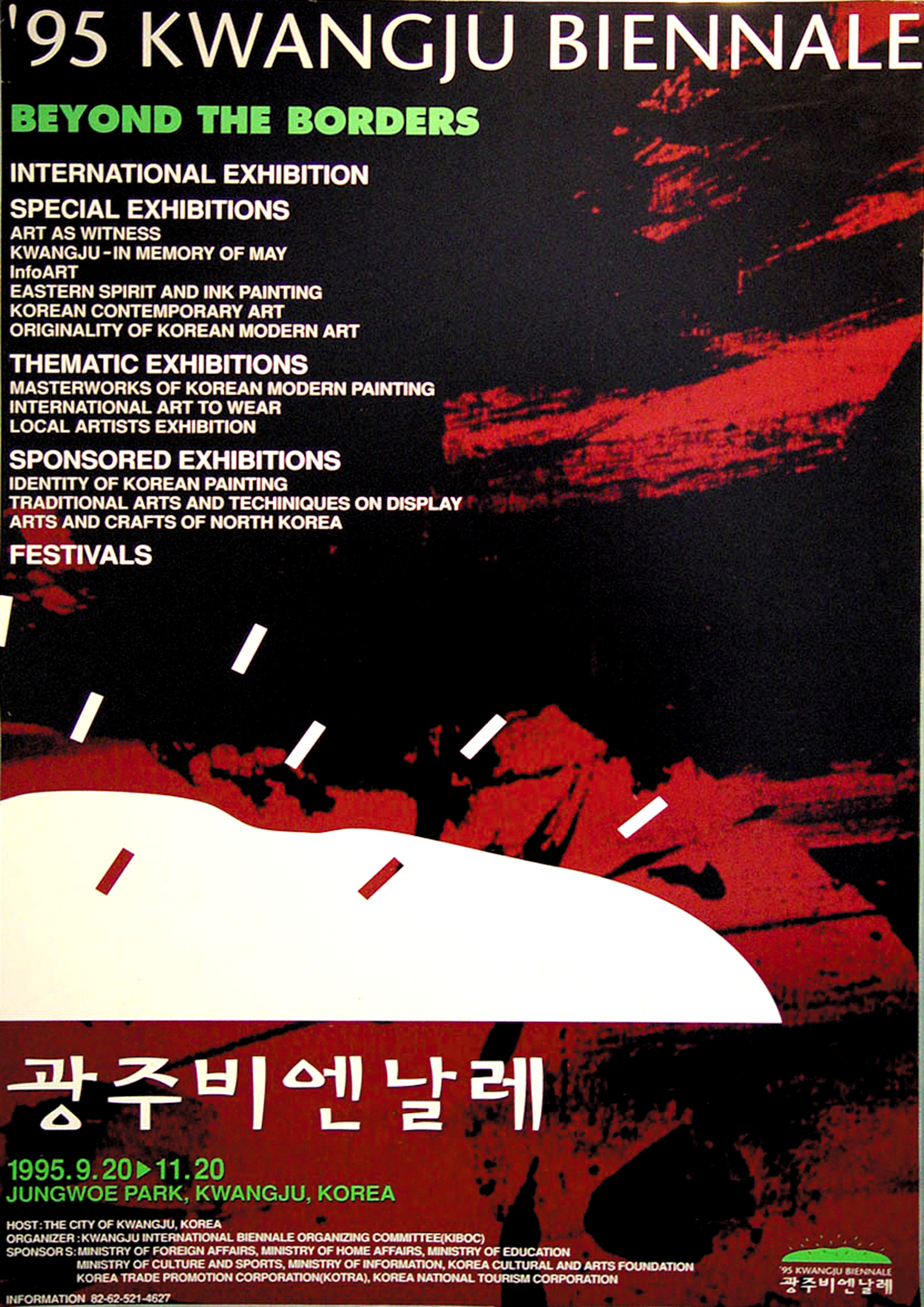
The first Gwangju Biennale, Poster, 1995, Courtesy of Gwangju Biennale Foundation.

View of the first Gwangju Biennale, 1995, Courtesy of Gwangju Biennale Foundation.
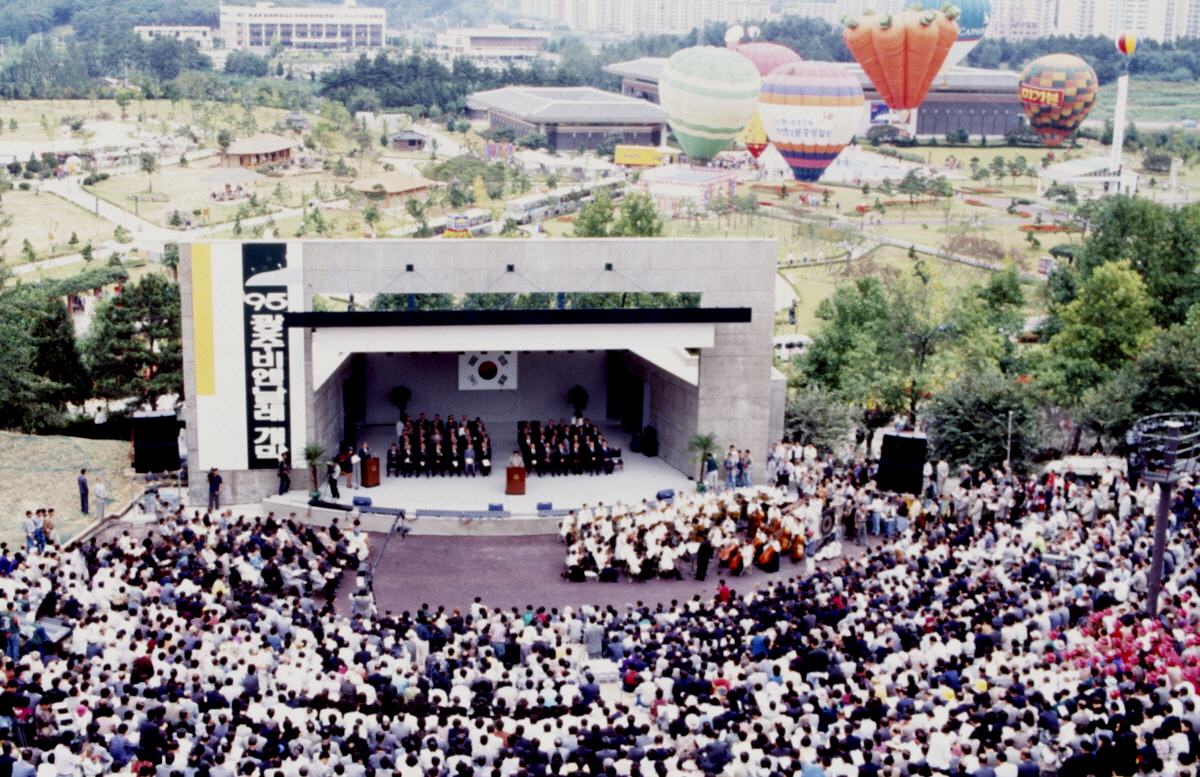
Opening Ceremony of the first Gwangju Biennale, 1995, Courtesy of Gwangju Biennale Foundation.
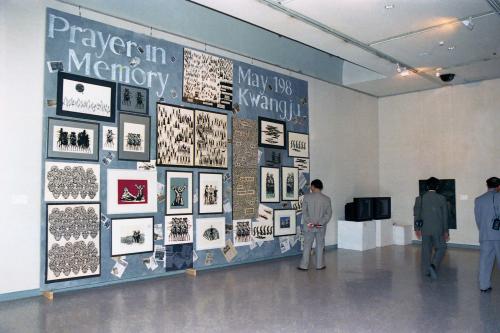
Installation view of Gwangju-in memory of May at the first Gwangju Biennale, 1995, Courtesy of e-Video History Archive.
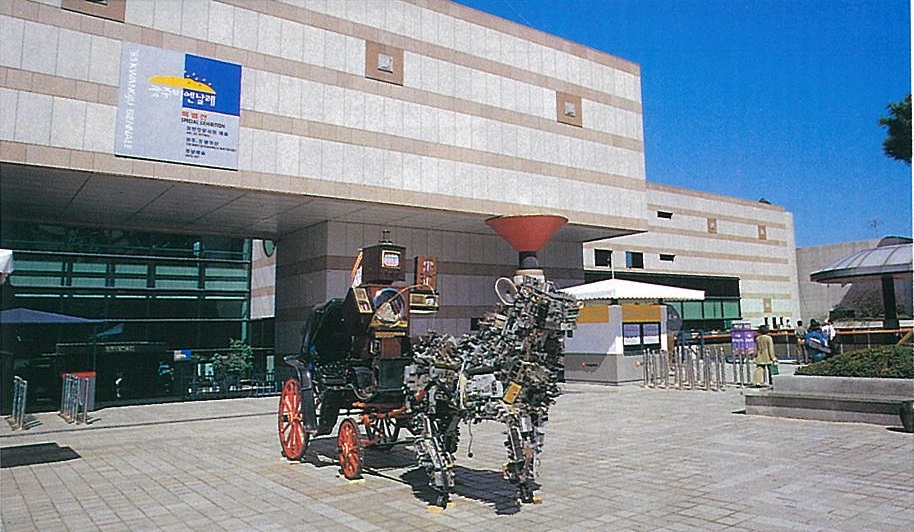
Paik Nam June, Electronic Transportation, Installation view of InfoART at the first Gwangju Biennale, Gana Art (November–December 1995): 59.
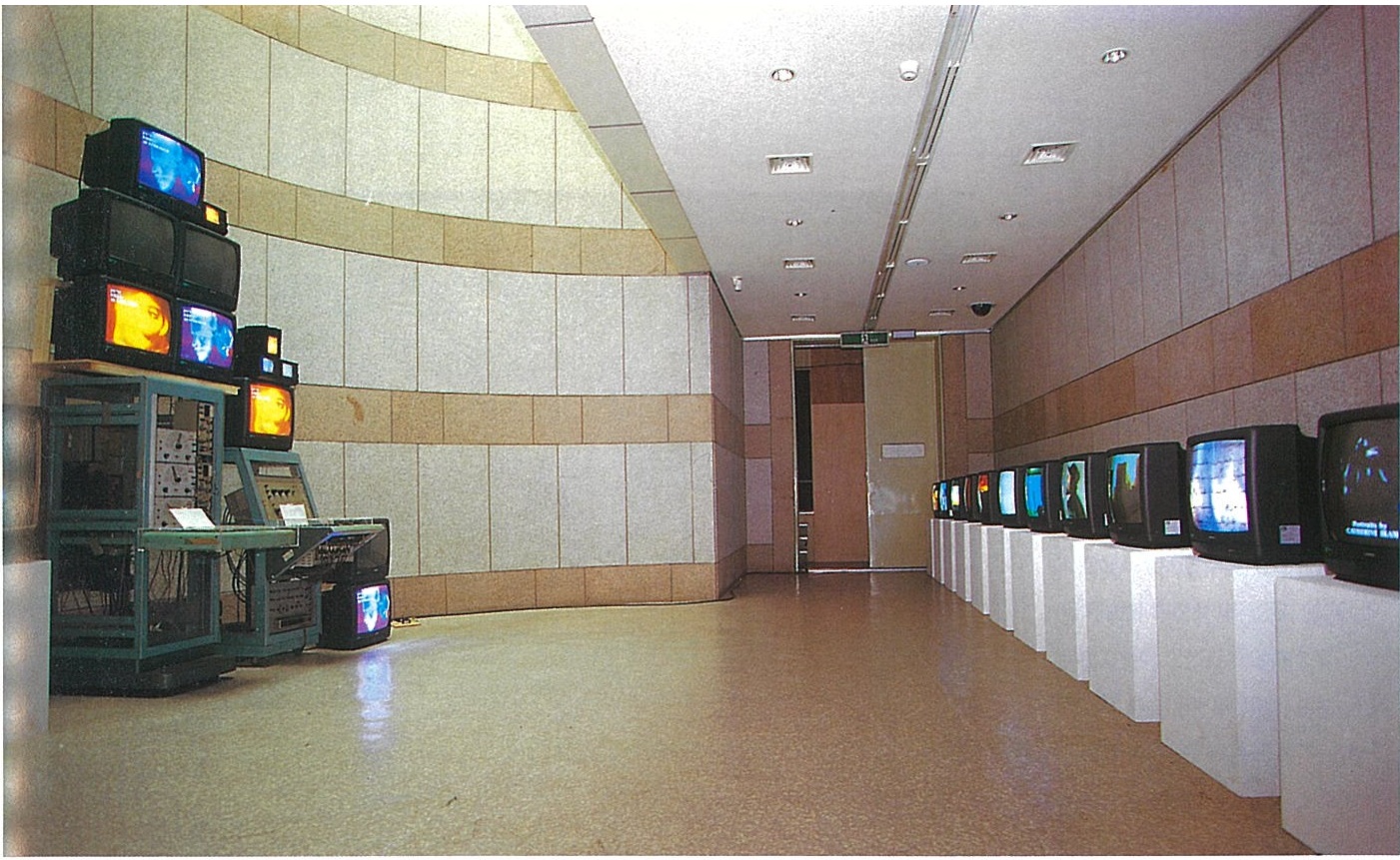
Installation view of InfoART at the first Gwangju Biennale, Gana Art (November–December 1995): 59.
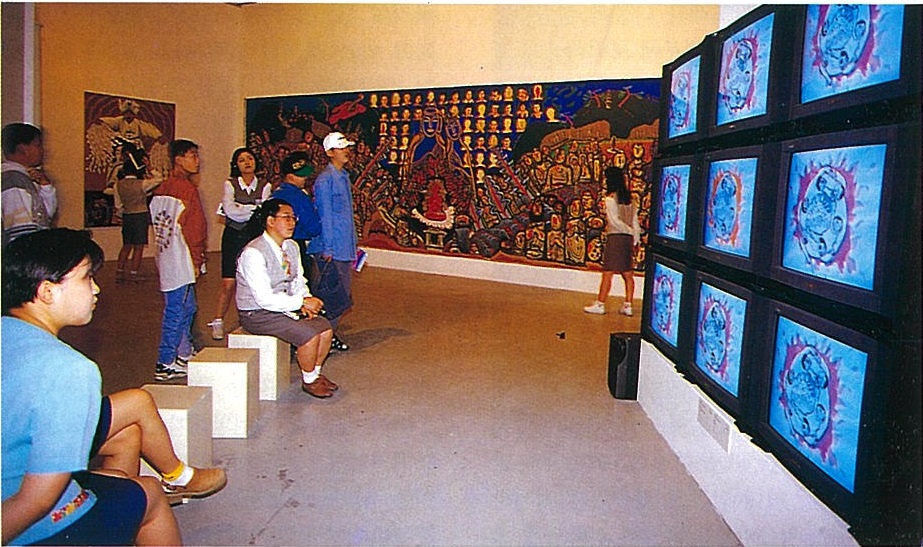
Installation view of the first Gwangju Biennale, 1995, Gana Art (November–December 1995): 59.
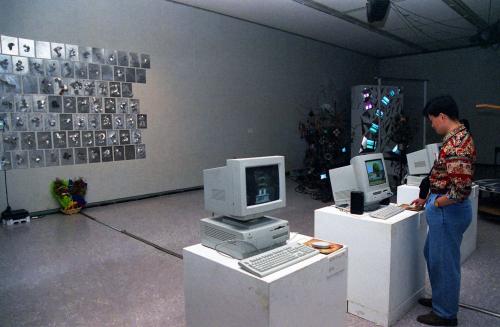
Installation view of InfoArt at the first Gwangju Biennale, 1995, Courtesy of e-Video History Archive.
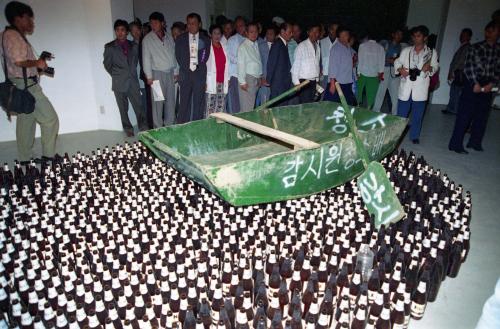
Kcho, To Forget, Installation view of the first Gwangju Biennale, 1995, Courtesy of e-Video History Archive.

Sign Up for Email Updates