
1. The National Museum of Modern and Contemporary Art (MMCA) was first established in 1969 at Gyeongbokgung Palace. In 1973, it relocated to the Seokjojeon Hall at Deoksugung Palace, and in 1986, it moved to Gwacheon following the completion of its first purpose-built museum facility. That same year, the museum established its first Exhibition Division and hired Kim Eunyoung, Kim Hyunsook, Ahn Soyeon, Lee Ihn Bum, and Lee Hwaik as curators. However, they were appointed not as curatorial researchers, but as special contract employees, and most resigned in the early 1990s. At the time, it was common practice for exhibition planning to be handled primarily by external art critics, while in-house curators were largely responsible for supporting the coordination of exhibitions. The introduction of the curatorial position system in 1989 and the appointment of Lim Youngbang as director in 1992 marked a turning point in the professionalization of curatorship in Korea. From 1994, Lim institutionalized Young Korean Artists as a regular exhibition and established the Korea Artist Prize exhibition, entrusting both programs entirely to in-house curators. This transition laid the foundation for curatorial specialization within the museum. Yi Juheon, “Assessing Museum Policy (Part 2): Ensuring Professionalism and Autonomy Remains the Top Priority," The Hankyoreh, Dec. 19, 1990; Yi Yongwu, “Culture-less Cultural Space (12): ‘MMCA’ (1) Useless 'Curatorial Department,” The Dong-A Ilbo, Dec. 1, 1992; Yim Beom, “New Exhibition Korean Art Exhibition to Be Held Biennially,” The Hankyoreh, July 7, 1994; Kim Seokjong, “A Star of the ‘Museum Era,’ Creating a New Cultural Paradigm,” Kyunghyang Shinmun, June 15, 1995.
2. Following the implementation of the Museum and Art Gallery Promotion Act in 1992, a wave of private art museums was established, including Ho-Am Gallery (1992), Total Museum of Contemporary Art (1992), Sungkok Art Museum (1995), Art Sonje Center (1995), Kumho Museum of Art (1996), and Ilmin Museum of Art (1996). As for public institutions, the Seoul Museum of Art, opened in 1988, was followed by the Gwangju Museum of Art (1992), Busan Museum of Art (1998), and Daejeon Museum of Art (1998), all of which were founded during the 1990s. Jung Hun-Yee, “Fine Art,” in Comprehensive History of Contemporary Korean Art, vol. 6, edited by Korean National Research Center for the Arts of the Korean National University of Arts (Seoul: Sigongsa, 2005), 245–246.
3. Between 1999 and 2000, Korea’s first-generation alternative art spaces—including Alternative Space LOOP, Alternative Space Pool, Project Space Sarubia, Ssamzie Space, and Insa Art Space—were established.
2. Following the implementation of the Museum and Art Gallery Promotion Act in 1992, a wave of private art museums was established, including Ho-Am Gallery (1992), Total Museum of Contemporary Art (1992), Sungkok Art Museum (1995), Art Sonje Center (1995), Kumho Museum of Art (1996), and Ilmin Museum of Art (1996). As for public institutions, the Seoul Museum of Art, opened in 1988, was followed by the Gwangju Museum of Art (1992), Busan Museum of Art (1998), and Daejeon Museum of Art (1998), all of which were founded during the 1990s. Jung Hun-Yee, “Fine Art,” in Comprehensive History of Contemporary Korean Art, vol. 6, edited by Korean National Research Center for the Arts of the Korean National University of Arts (Seoul: Sigongsa, 2005), 245–246.
3. Between 1999 and 2000, Korea’s first-generation alternative art spaces—including Alternative Space LOOP, Alternative Space Pool, Project Space Sarubia, Ssamzie Space, and Insa Art Space—were established.
Jeon Yushin
Korea’s First Generation of Curators and the Overseas Exhibitions of Contemporary Korean Art
Exhibitions intended to introduce contemporary Korean art abroad have been held since the 1950s; however, the 1990s are widely regarded as a turning point in the history of such efforts. From this period onward, the number of exhibitions of contemporary Korean art held internationally increased significantly, and the proportion of those presented in the West far surpassed those in Asia. These shifts can be attributed largely to the convergence of globalizing trends and the globalization policies promoted by Korea’s civilian government, which together spurred a marked rise in international cultural exchange in the field of art.
Exhibitions of contemporary Korean art are, by nature, closely tied to the notion of “Koreanness,” in that they often foreground national identity. What this essay seeks to examine in particular is the question of who has defined and selected the “Koreanness” represented in these exhibitions. An exhibition is a curatorial act in which subjects are selected and arranged according to specific criteria—and such criteria, that is, the curatorial intent, are shaped by the context in which the curator is situated. Focusing on the curatorial agents behind exhibitions of contemporary Korean art held in the West during the 1990s and 2000s allows us to examine how each exhibition, shaped by their own context, defined and selected what constituted contemporary Korean art. This essay analyzes representative case studies of such exhibitions in the West, with particular attention to how the curators’ respective contexts were reflected in the framing and presentation of contemporary Korean art.
The first generation of curators in the Korean art world consisted primarily of figures who were originally active as art critics, including Park Raegyung, Oh Kwang-su, Yu Jun-sang, Lee Kyungsung, Lee Yil, and Lim Youngbang. A distinct group of younger curators began to emerge collectively in the 1990s. If the introduction of the curatorial position at the National Museum of Modern and Contemporary Art (then National Museum of Contemporary Art) in 1989 marked the institutional beginning of curatorship in Korea,1 the rapid increase in museum establishments during the 1990s—and the resulting rise in demand for curators—served as a key catalyst for the collective emergence of this second generation of curators. In the early 1990s, the enforcement of the Museum and Art Gallery Promotion Act led to a rapid increase in the establishment of private art museums, while the reinstatement of local self-governance spurred the growth of public art museums at the municipal level.2 By the late 1990s, the emergence of alternative art spaces further diversified the types of institutional frameworks that required curators, contributing to the expansion of curatorial roles across the field.3
The dominant discourse in the Korean art world of the 1990s—when the emergence of the second generation of curators became firmly established—centered on “internationalization and globalization.” As globalization became a worldwide phenomenon, the Kim Young-sam administration, inaugurated in 1993, adopted it as a key policy agenda, extending its influence into the cultural and artistic spheres. That same year, the Korean Culture and Arts Foundation (now Arts Council Korea) declared 1993 the “Year of Korean Culture Globalization,” while the Ministry of Culture and Sports identified “the globalization of Korean culture” as one of its three major policy initiatives for 1995. The broader cultural sector actively embraced the discourse of internationalization and globalization. In particular, 1995, designated the “Year of Art” by the Ministry of Culture and Sports, marked a turning point as concrete efforts to globalize Korean art were realized through initiatives such as the establishment of the Korean Pavilion at the Venice Biennale and the launch of the inaugural Gwangju Biennale. Throughout the 1990s, contemporary Korean art exhibitions—including those at the Korean Pavilion—and biennales such as the Gwangju Biennale served as key platforms for both artists and curators to gain a foothold on the international stage.
Among them, the list of curators who organized the Korean Pavilion exhibitions at the Venice Biennale serves as a representative sample of the key figures behind contemporary Korean art exhibitions, as well as an indicator of the evolving curatorial landscape. In the 1990s, first-generation curators such as Lee Yil, Oh Kwang-su, and Song Misook were primarily responsible for organizing exhibitions of contemporary Korean art. In the 2000s, second-generation curators—such as Park Kyungmi, Kim Hong-hee, Kim Sunjung, Ahn Soyeon, Lee Sook-Kyung, and Yoon Jae-gap—who began their careers in the 1990s at institutions including the National Museum of Contemporary Art (now the National Museum of Modern and Contemporary Art, MMCA), private museums, alternative spaces, and commercial galleries, emerged as key figures in organizing such exhibitions. In addition, internationally trained curators such as Kim Seungduk and Joo Eungie also played a prominent role in shaping the field during this period.
In the 1990s, the principal curatorial agents behind exhibitions of contemporary Korean art were first-generation curators and the National Museum of Contemporary Art. These figures emphasized naturalism and East Asian tradition as core elements of “Koreanness.” At the National Museum of Contemporary Art, from its relocation to Gwacheon in 1986 until the early 2000s, individuals such as Lee Kyungsung, Lim Youngbang, Choi Manlin, and Oh Kwang-su—modernist artists and critics who also represented the first generation of curators—served as museum directors. As such, the museum exemplifies the close relationship between first-generation curators and the shaping of contemporary Korean art exhibitions. In contrast, exhibitions curated by second-generation curators frequently foregrounded Korea’s political and social realities as defining features of contemporary Korean art. These two curatorial frameworks have continued to be widely adopted in exhibitions since the 1990s.
*This essay is a revised version of the author’s earlier essay, “Exhibitions of Contemporary Korean Art Held Overseas,” originally published in Contemporary Korean Art Since the 1990s (co-authored by Yun Nanji et al., planned by the Forum for Contemporary Art, Seoul: Sahoipyoungnon, 2017).

Exhibitions of contemporary Korean art are, by nature, closely tied to the notion of “Koreanness,” in that they often foreground national identity. What this essay seeks to examine in particular is the question of who has defined and selected the “Koreanness” represented in these exhibitions. An exhibition is a curatorial act in which subjects are selected and arranged according to specific criteria—and such criteria, that is, the curatorial intent, are shaped by the context in which the curator is situated. Focusing on the curatorial agents behind exhibitions of contemporary Korean art held in the West during the 1990s and 2000s allows us to examine how each exhibition, shaped by their own context, defined and selected what constituted contemporary Korean art. This essay analyzes representative case studies of such exhibitions in the West, with particular attention to how the curators’ respective contexts were reflected in the framing and presentation of contemporary Korean art.
The first generation of curators in the Korean art world consisted primarily of figures who were originally active as art critics, including Park Raegyung, Oh Kwang-su, Yu Jun-sang, Lee Kyungsung, Lee Yil, and Lim Youngbang. A distinct group of younger curators began to emerge collectively in the 1990s. If the introduction of the curatorial position at the National Museum of Modern and Contemporary Art (then National Museum of Contemporary Art) in 1989 marked the institutional beginning of curatorship in Korea,1 the rapid increase in museum establishments during the 1990s—and the resulting rise in demand for curators—served as a key catalyst for the collective emergence of this second generation of curators. In the early 1990s, the enforcement of the Museum and Art Gallery Promotion Act led to a rapid increase in the establishment of private art museums, while the reinstatement of local self-governance spurred the growth of public art museums at the municipal level.2 By the late 1990s, the emergence of alternative art spaces further diversified the types of institutional frameworks that required curators, contributing to the expansion of curatorial roles across the field.3
The dominant discourse in the Korean art world of the 1990s—when the emergence of the second generation of curators became firmly established—centered on “internationalization and globalization.” As globalization became a worldwide phenomenon, the Kim Young-sam administration, inaugurated in 1993, adopted it as a key policy agenda, extending its influence into the cultural and artistic spheres. That same year, the Korean Culture and Arts Foundation (now Arts Council Korea) declared 1993 the “Year of Korean Culture Globalization,” while the Ministry of Culture and Sports identified “the globalization of Korean culture” as one of its three major policy initiatives for 1995. The broader cultural sector actively embraced the discourse of internationalization and globalization. In particular, 1995, designated the “Year of Art” by the Ministry of Culture and Sports, marked a turning point as concrete efforts to globalize Korean art were realized through initiatives such as the establishment of the Korean Pavilion at the Venice Biennale and the launch of the inaugural Gwangju Biennale. Throughout the 1990s, contemporary Korean art exhibitions—including those at the Korean Pavilion—and biennales such as the Gwangju Biennale served as key platforms for both artists and curators to gain a foothold on the international stage.
Among them, the list of curators who organized the Korean Pavilion exhibitions at the Venice Biennale serves as a representative sample of the key figures behind contemporary Korean art exhibitions, as well as an indicator of the evolving curatorial landscape. In the 1990s, first-generation curators such as Lee Yil, Oh Kwang-su, and Song Misook were primarily responsible for organizing exhibitions of contemporary Korean art. In the 2000s, second-generation curators—such as Park Kyungmi, Kim Hong-hee, Kim Sunjung, Ahn Soyeon, Lee Sook-Kyung, and Yoon Jae-gap—who began their careers in the 1990s at institutions including the National Museum of Contemporary Art (now the National Museum of Modern and Contemporary Art, MMCA), private museums, alternative spaces, and commercial galleries, emerged as key figures in organizing such exhibitions. In addition, internationally trained curators such as Kim Seungduk and Joo Eungie also played a prominent role in shaping the field during this period.
In the 1990s, the principal curatorial agents behind exhibitions of contemporary Korean art were first-generation curators and the National Museum of Contemporary Art. These figures emphasized naturalism and East Asian tradition as core elements of “Koreanness.” At the National Museum of Contemporary Art, from its relocation to Gwacheon in 1986 until the early 2000s, individuals such as Lee Kyungsung, Lim Youngbang, Choi Manlin, and Oh Kwang-su—modernist artists and critics who also represented the first generation of curators—served as museum directors. As such, the museum exemplifies the close relationship between first-generation curators and the shaping of contemporary Korean art exhibitions. In contrast, exhibitions curated by second-generation curators frequently foregrounded Korea’s political and social realities as defining features of contemporary Korean art. These two curatorial frameworks have continued to be widely adopted in exhibitions since the 1990s.
*This essay is a revised version of the author’s earlier essay, “Exhibitions of Contemporary Korean Art Held Overseas,” originally published in Contemporary Korean Art Since the 1990s (co-authored by Yun Nanji et al., planned by the Forum for Contemporary Art, Seoul: Sahoipyoungnon, 2017).
- Share
 Copy URL
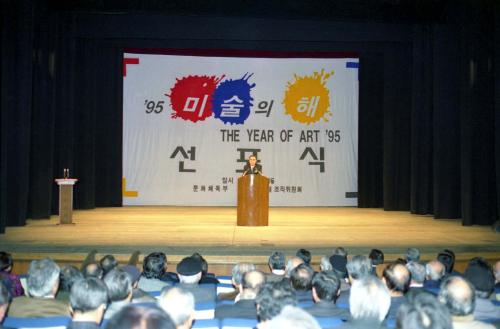
Proclamation Ceremony for the Year of Art ’95, 1995, Courtesy of e-Video History Archive.
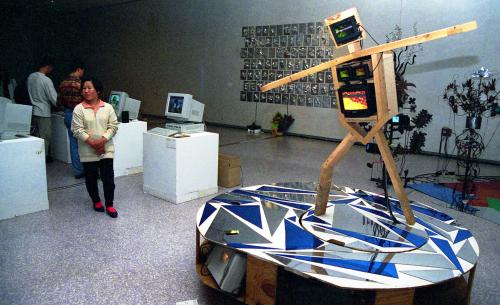
Installation view of the first Gwangju Biennale, 1995, Courtesy of e-Video History Archive.

Sign Up for Email Updates