1. Since 1993, when the Ministry of Culture, Sports and Tourism and the Korean Culture and Arts Foundation (now the Arts Council Korea) took the lead in establishing the Korean Pavilion, the authority over the operation of its exhibitions began shifting from the Korean Fine Arts Association to the Foundation. However, even after this transition, the Korean Fine Arts Association continued to be partially involved in the operation of the Korean Pavilion at the Venice Biennale until the relationship was formally concluded in 2011. Ho Kyoungyun, “Thirty Tumultuous Years: Reconnecting a Broken Trajectory,” in The Last Pavilion ─ The Archival Publication of the Korean Pavilion at the Venice Biennale (Seoul: Arts Council Korea, 2024), 253–255.
2. Lee Yil, “On the Opening of the Korean Pavilion at the Venice Biennale,” Misul Segye, no. 122 (January 1995): 85.
3. “Domestic commentary at the time regarding Jheon Soocheon’s Special Award win expressed concern over the compulsive logic that Korean art must demonstrate “our own”—something inherently Korean and lacking in the West. This prompted a reflexive response toward traditional themes and museum-like motifs.” Yoo Jaekil and Kim Taekyong, “A Study on The Korean Pavilion of Venice Biennale - Focusing on the relation between the Korean pavilion and the changes in the discourse of Global Art,” Journal of Basic Design & Art 11, no. 6 (2010): 385.
4. Oh Kwang-su, “Exhibition Foreword,” in La Biennale di Venezia 1997 Republic of Korea (Seoul: Korean Culture and Arts Foundation, 1997), Page number not available.
5. Ibid.
2. Lee Yil, “On the Opening of the Korean Pavilion at the Venice Biennale,” Misul Segye, no. 122 (January 1995): 85.
3. “Domestic commentary at the time regarding Jheon Soocheon’s Special Award win expressed concern over the compulsive logic that Korean art must demonstrate “our own”—something inherently Korean and lacking in the West. This prompted a reflexive response toward traditional themes and museum-like motifs.” Yoo Jaekil and Kim Taekyong, “A Study on The Korean Pavilion of Venice Biennale - Focusing on the relation between the Korean pavilion and the changes in the discourse of Global Art,” Journal of Basic Design & Art 11, no. 6 (2010): 385.
4. Oh Kwang-su, “Exhibition Foreword,” in La Biennale di Venezia 1997 Republic of Korea (Seoul: Korean Culture and Arts Foundation, 1997), Page number not available.
5. Ibid.
Kim Hong-Ki
The Korean Pavilion at the Venice Biennale (1995–1997): Globalizing the Aesthetic Traditions of Korea
Although the official exhibitions of the Korean Pavilion at the Venice Biennale, established in the Giardini Park, Venice, began in 1995, Korea's engagement with the Biennale has an earlier history, with four participations up to 1993. Before the inauguration of the dedicated national pavilion in the Giardini in 1993, Korea took part in the Biennale on four occasions, beginning in 1986. During this early period, Korea organized its exhibitions, in the absence of a permanent pavilion, by setting up temporary booths within the Arsenale, one of the main venues of the Biennale. These exhibitions were organized by the Korean Fine Arts Association. Except for the 1986 exhibition, commissioned by art critic Lee Yil, the participating artists served concurrently as commissioners. Ha Chonghyun served in this capacity in 1988, followed by Lee Seung-taek in 1990 and Suh Seungwon in 1993. While a few younger artists such as Ko Younghoon and Kim Kwansoo participated in their mid-thirties, the majority were established mid-career artists in their forties and fifties, including Park Seo-Bo, Cho Sungmook, Ha Dongchul, Ha Chonghyun, and Hong Myung-seop. Importantly, the exhibited works predominantly employed simple and traditional media, such as painting and sculpture.
The inaugural exhibition at Korea’s national pavilion in the Giardini in 1995 marked a transitional phase, from the former system led by the Korean Fine Arts Association to the current system overseen by the Korean Culture and Arts Foundation (now the Arts Council Korea).1 This transitional character was exemplified by the reappointment of Lee Yil, who had previously served as commissioner in 1986, and the relatively high age range of the participating artists (Kwak Hoon, Kim Inkyum, Yun Hyongkeun, and Jheon Soocheon), who were in their forties and sixties, signaling continuity with the earlier legacy and system. However, the exhibition also marked a shift in artistic direction. While Yun Hyongkeun was the only artist to present a painting, Kwak Hoon, Kim Inkyum, and Jheon Soocheon exhibited installation works. This shift reflected a clear departure from the earlier dominance of painting, highlighting a great diversity of artistic media.
In a statement published shortly before the opening of the Korean Pavilion and its inaugural exhibition, Commissioner Lee Yil addressed the discourse of globalization by asserting that “While promoting the global dissemination of Korean art, we should actively invite and engage with international-scale foreign art within Korea.”2 His remarks emphasized an understanding of globalization not as a unidirectional movement enabling Korean art to enter the international stage, but as a reciprocal and dialogic process of exchange between Korean and international artistic spheres. This bilateral conception of globalization was institutionally realized through two major initiatives launched in 1995: the Gwangju Biennale and the Korean Pavilion at the Venice Biennale. While the Gwangju Biennale sought to bring large-scale international art into Korea, the Korean Pavilion was envisioned as a strategic platform for amplifying the presence of Korean art and artists globally. However, this understanding of globalization rested on a tacitly accepted binary between “Korean art” and “international art.” The very premise of promoting mutual exchange presupposed their ontological distinction between Korean and international art. Within such a framework, the imperative of globalization becomes the identification and promotion of what is constructed as uniquely Korean, something defined in contrast to, and presumed absent from, international art.
Among the artists featured in the inaugural exhibition of the Korean Pavilion, Jheon Soocheon garnered particular attention by receiving a special award for his installation Clay Icon in Wandering Planets―Korean’s Spirit, a work composed of industrial waste, TV monitors, and traditional clay figurines fired in Gyeongju. While this recognition at the Korean Pavilion’s inaugural exhibition marked a significant achievement, it simultaneously reinforced the belief that Korean art’s distinctiveness resides in its traditional cultural signifiers, exemplified here by the figurines made in Gyeongju. It is widely acknowledged that, even at the time, concerns were raised about the Orientalist framing that juxtaposed Western artistic modernity with Korean cultural traditionalism.3 Nonetheless, the view that Korean art's global identity should be grounded in traditional aesthetics persisted, a perspective notably carried forward into the Korean Pavilion's subsequent exhibition in 1997.
The commissioner of the Korean Pavilion’s 1997 exhibition was Oh Kwang-su. Like Lee Yil, who had overseen the Pavilion’s inaugural exhibition, Oh was a prominent art critic. The appointment of a professional curator as commissioner did not occur until 2001. Oh Kwang-su selected two artists for the 1997 exhibition: Kang Ik-Joong and Lee Hyungwoo. Both were relatively young, in their thirties and forties, and had studied abroad after graduating from the College of Fine Arts at Hongik University. Kang, born in 1960, pursued his education in New York and continued his artistic practice there. Born in 1955, Lee studied in Paris and Rome before returning to Korea, where he actively engaged in both artistic practice and art education. The decision to feature two internationally educated, mid-career artists with substantial overseas experience suggests that, within the discourse of Korean art’s globalization, preference was given to artists who had attuned to the universalist of global contemporary art, rather than those focused on articulating the authenticity of Korean art.
In discussing the mediums employed by the participating artists, Oh Kwang-su emphasized that both were deeply committed to exploring the most traditional medium of fine art: painting and sculpture. He commented; “This year’s Venice Biennale features two artists: Kang Ik-Joong in painting, and Lee Hyungwoo in sculpture. [...] However, Kang Ik-Joong’s paintings and Lee Hyungwoo’s sculptures depart from painting or sculpture but relentlessly return to their respective mediums, showing a consciousness of return.”4 However, the practices of Kang and Lee also possessed a transmedial quality that could not be fully accounted for by a mere “consciousness of return.” Though Kang is typically identified as a painter, his exhibited piece displayed pronounced characteristics of installation. It consisted of over 13,000 small, three-inch square wooden reliefs, arranged in a grid, capturing everything ranging from childhood memories to scenes of daily life in New York. Each grouping bore subtitles such as Buddha Singing Opera, Let’s Learn Chinese Characters, and Making Bibimbap. Similarly, Lee’s work, though classified as sculpture, also took on the character of installation. His series, titled The There Is, comprised geometric forms constructed from barbed wire, terracotta, and wood, materials not typically associated with traditional sculpture. Notably, the works featured small, varied objects arranged in grid formations on the floor, along with translucent barbed-wire structures affixed to gallery windows, which clearly demonstrated a departure from the conventional boundaries of sculptural practice.
Following Jheon Soocheon and Kang Ik-Joong’s receipt of a special prize marked a second consecutive win for the Korean Pavilion. Kang frequently likened his work to ‘bibimbap’, a metaphor he also used in the subtitles of his exhibited pieces. This metaphor is open to dual interpretation. On one hand, bibimbap, as a distinctly Korean dish, can be interpreted as emphasizing the traditional aesthetics of Korean art. On the other hand, its assemblage of heterogeneous ingredients may serve as a metaphor for the universalist tendencies in Kang’s practice, traversing clear boundaries such as Korean and international, self and other, and tradition and modernity. Faced with these two interpretive trajectories, tradition and universality, Commissioner Oh Kwang-su justified the selection of the two artists by asserting that their works contained “fragments of traditional Korean aesthetics” despite their “universal sensibility.”5 Kang’s small images were interpreted as evocative of talismans or folk paintings, Minhwa, while Lee’s cubic objects were seen as reminiscent of household artifacts or discarded wooden vessels from old farmhouses in rural settings. As with the previous exhibition, Korean specificity was once again sought in traditional aesthetics to define Korea’s position in an era of globalization.

The inaugural exhibition at Korea’s national pavilion in the Giardini in 1995 marked a transitional phase, from the former system led by the Korean Fine Arts Association to the current system overseen by the Korean Culture and Arts Foundation (now the Arts Council Korea).1 This transitional character was exemplified by the reappointment of Lee Yil, who had previously served as commissioner in 1986, and the relatively high age range of the participating artists (Kwak Hoon, Kim Inkyum, Yun Hyongkeun, and Jheon Soocheon), who were in their forties and sixties, signaling continuity with the earlier legacy and system. However, the exhibition also marked a shift in artistic direction. While Yun Hyongkeun was the only artist to present a painting, Kwak Hoon, Kim Inkyum, and Jheon Soocheon exhibited installation works. This shift reflected a clear departure from the earlier dominance of painting, highlighting a great diversity of artistic media.
In a statement published shortly before the opening of the Korean Pavilion and its inaugural exhibition, Commissioner Lee Yil addressed the discourse of globalization by asserting that “While promoting the global dissemination of Korean art, we should actively invite and engage with international-scale foreign art within Korea.”2 His remarks emphasized an understanding of globalization not as a unidirectional movement enabling Korean art to enter the international stage, but as a reciprocal and dialogic process of exchange between Korean and international artistic spheres. This bilateral conception of globalization was institutionally realized through two major initiatives launched in 1995: the Gwangju Biennale and the Korean Pavilion at the Venice Biennale. While the Gwangju Biennale sought to bring large-scale international art into Korea, the Korean Pavilion was envisioned as a strategic platform for amplifying the presence of Korean art and artists globally. However, this understanding of globalization rested on a tacitly accepted binary between “Korean art” and “international art.” The very premise of promoting mutual exchange presupposed their ontological distinction between Korean and international art. Within such a framework, the imperative of globalization becomes the identification and promotion of what is constructed as uniquely Korean, something defined in contrast to, and presumed absent from, international art.
Among the artists featured in the inaugural exhibition of the Korean Pavilion, Jheon Soocheon garnered particular attention by receiving a special award for his installation Clay Icon in Wandering Planets―Korean’s Spirit, a work composed of industrial waste, TV monitors, and traditional clay figurines fired in Gyeongju. While this recognition at the Korean Pavilion’s inaugural exhibition marked a significant achievement, it simultaneously reinforced the belief that Korean art’s distinctiveness resides in its traditional cultural signifiers, exemplified here by the figurines made in Gyeongju. It is widely acknowledged that, even at the time, concerns were raised about the Orientalist framing that juxtaposed Western artistic modernity with Korean cultural traditionalism.3 Nonetheless, the view that Korean art's global identity should be grounded in traditional aesthetics persisted, a perspective notably carried forward into the Korean Pavilion's subsequent exhibition in 1997.
The commissioner of the Korean Pavilion’s 1997 exhibition was Oh Kwang-su. Like Lee Yil, who had overseen the Pavilion’s inaugural exhibition, Oh was a prominent art critic. The appointment of a professional curator as commissioner did not occur until 2001. Oh Kwang-su selected two artists for the 1997 exhibition: Kang Ik-Joong and Lee Hyungwoo. Both were relatively young, in their thirties and forties, and had studied abroad after graduating from the College of Fine Arts at Hongik University. Kang, born in 1960, pursued his education in New York and continued his artistic practice there. Born in 1955, Lee studied in Paris and Rome before returning to Korea, where he actively engaged in both artistic practice and art education. The decision to feature two internationally educated, mid-career artists with substantial overseas experience suggests that, within the discourse of Korean art’s globalization, preference was given to artists who had attuned to the universalist of global contemporary art, rather than those focused on articulating the authenticity of Korean art.
In discussing the mediums employed by the participating artists, Oh Kwang-su emphasized that both were deeply committed to exploring the most traditional medium of fine art: painting and sculpture. He commented; “This year’s Venice Biennale features two artists: Kang Ik-Joong in painting, and Lee Hyungwoo in sculpture. [...] However, Kang Ik-Joong’s paintings and Lee Hyungwoo’s sculptures depart from painting or sculpture but relentlessly return to their respective mediums, showing a consciousness of return.”4 However, the practices of Kang and Lee also possessed a transmedial quality that could not be fully accounted for by a mere “consciousness of return.” Though Kang is typically identified as a painter, his exhibited piece displayed pronounced characteristics of installation. It consisted of over 13,000 small, three-inch square wooden reliefs, arranged in a grid, capturing everything ranging from childhood memories to scenes of daily life in New York. Each grouping bore subtitles such as Buddha Singing Opera, Let’s Learn Chinese Characters, and Making Bibimbap. Similarly, Lee’s work, though classified as sculpture, also took on the character of installation. His series, titled The There Is, comprised geometric forms constructed from barbed wire, terracotta, and wood, materials not typically associated with traditional sculpture. Notably, the works featured small, varied objects arranged in grid formations on the floor, along with translucent barbed-wire structures affixed to gallery windows, which clearly demonstrated a departure from the conventional boundaries of sculptural practice.
Following Jheon Soocheon and Kang Ik-Joong’s receipt of a special prize marked a second consecutive win for the Korean Pavilion. Kang frequently likened his work to ‘bibimbap’, a metaphor he also used in the subtitles of his exhibited pieces. This metaphor is open to dual interpretation. On one hand, bibimbap, as a distinctly Korean dish, can be interpreted as emphasizing the traditional aesthetics of Korean art. On the other hand, its assemblage of heterogeneous ingredients may serve as a metaphor for the universalist tendencies in Kang’s practice, traversing clear boundaries such as Korean and international, self and other, and tradition and modernity. Faced with these two interpretive trajectories, tradition and universality, Commissioner Oh Kwang-su justified the selection of the two artists by asserting that their works contained “fragments of traditional Korean aesthetics” despite their “universal sensibility.”5 Kang’s small images were interpreted as evocative of talismans or folk paintings, Minhwa, while Lee’s cubic objects were seen as reminiscent of household artifacts or discarded wooden vessels from old farmhouses in rural settings. As with the previous exhibition, Korean specificity was once again sought in traditional aesthetics to define Korea’s position in an era of globalization.
- Share
 Copy URL
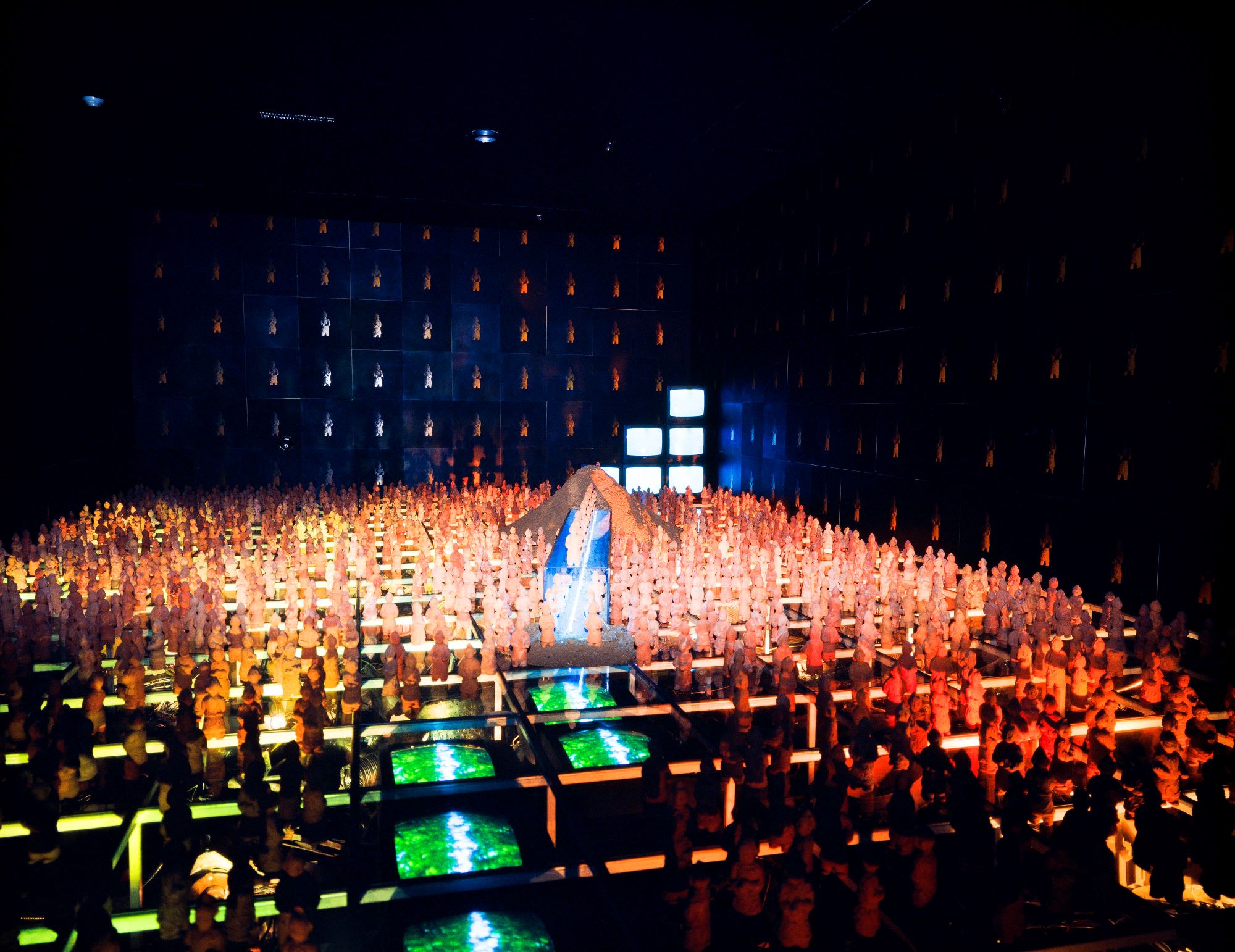
Jheon Soocheon, Clay Icon in Wandering Planets-Korean's Spirit, 1995, TV monitors, VCR, glass, clay figures, industrial waste, yellow soil, metal frames, screenprint on paper, 380×1800×800 cm. MMCA Collection.

Kang Ikjoong, Buddha Singing Opera, 1997. Courtesy of Art in Culture.
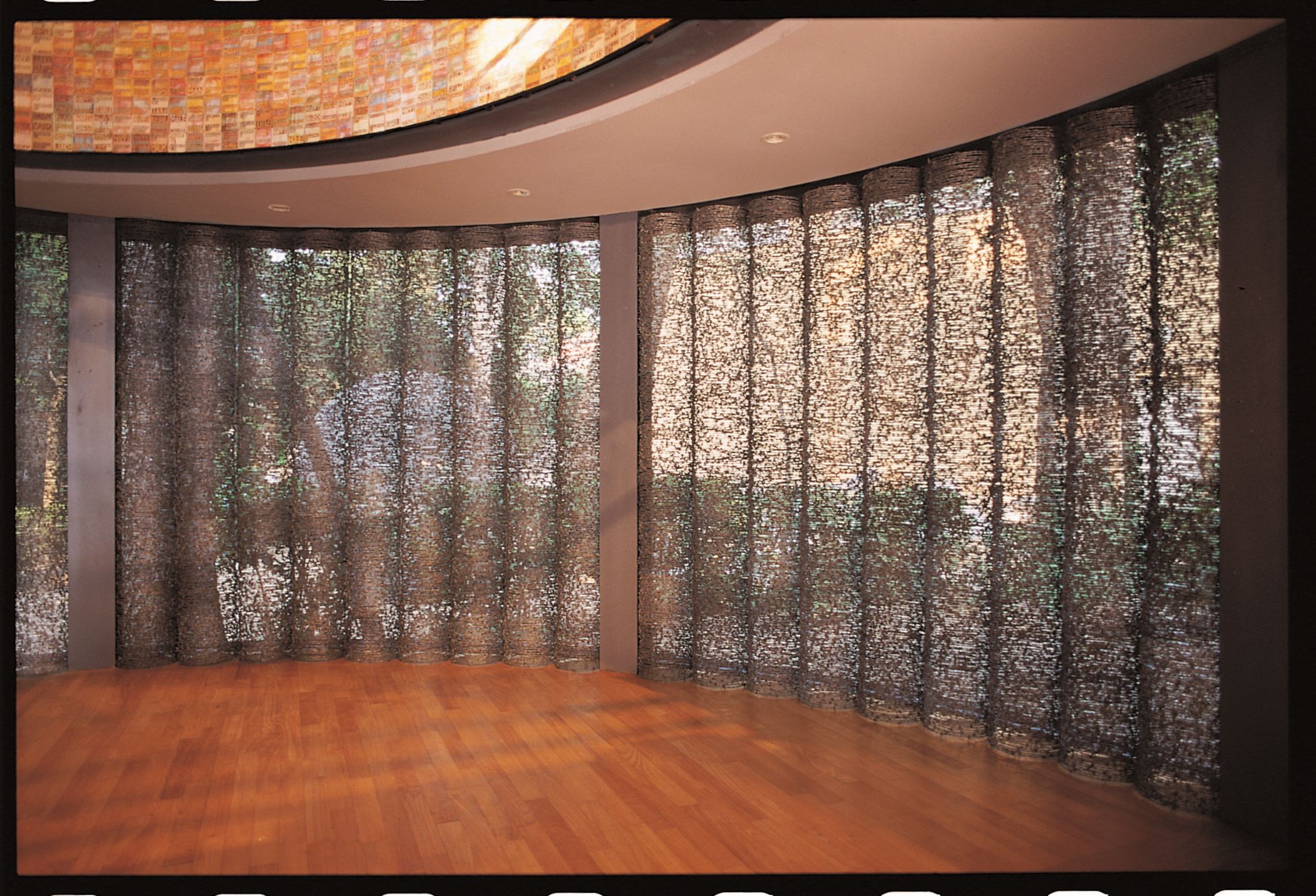
Lee Hyungwoo, Complete Existence, 1997, thorns and barbed wire, variable size. Courtesy of Art in Culture.

Sign Up for Email Updates